Monday, July 2, 2012

Home Exchanges: a wonderful way to experience the world


Regular visitors to this blog know that Sally and I are big fans of home exchanges.  This year we are on our 10th exchange in Blackrock, a small Irish village near Dundalk in County Louth. We hadn’t planned to come to Ireland this year…instead we were thinking of Germany or Switzerland. But we were approached by an Irish couple who lived in what looked like a very beautiful house on Old Golf Links Road, and I was sold.

We were last in Ireland in 2008 when we spent time in Lismore in County Waterford and explored the south and the west. We had a wonderful time, exploring tidy towns and playing golf. (Lahinch was a highlight). This year’s house is half way between Dublin and Belfast…about an hour from each, and offers us a chance to explore Northern Ireland.

As I reflect on past exchanges, I am reminded of some true adventures.  Our first exchange was in summer 1999 in a large terrace house in Sterling, Scotland. I’ll never forget Claire wandering around the house searching for bathrooms. She had never been in a house with only one bathroom before!  The location was a great base to explore Glasgow and Edinburgh and there must have been 20 golf courses nearby.  I used to set off each morning for 18 holes before the family work up and got ready. It was paradise.

One year we were on the island of Anguilla in the Caribbean.  The island was rustic…or should I say authentic.  I’ll never forget going into the local fish store only to find no fish. It was like a scene right out of a Monty Python sketch.  “Come at 5” the lady behind the counter told me.  That’s when the fishermen bring in their catch.  I was there at 4:30 and that particular day the fish arrived around 7:30, which was fine except that by the time I got home it was too dark to see to barbq them!

Golf was an adventure since we had to take a ferry to St Martin to play. It’s the only time in my life I had to show my passport twice en route to a round of golf.

One year I really wanted to go to Spain, but no one was responding to my invitations. So one evening after too much scotch, I started writing to people in every country that started with‘s’. We soon got a reply from someone in Lerum, just outside of Gothenburg, Sweden.  It was a great adventure. Golf there was interesting…since on my first round I was accompanied by someone without clubs. He was monitoring the play.  It seems that in Sweden you need the equivalent of a driver’s license before you are allowed on a course to play. He was writing his ‘road test’.

In Australia we had a big new house in a Sydney suburb with a lovely swimming pool where large wild birds would come in for a swim from the adjacent bush. Christmas dinner included many different types of prawns and Queensland Bugs with the kids and our friends Mary and Gary Hiscox who happened to be visiting the country at the time. 

Golf at Castle Hill was an adventure since they wouldn’t let me on the course with North American golfers’ socks.  They were too short.  They wanted me to wear longer calf-length socks…the type that are not allowed in Canada!  They gave me a pair with the club’s crest.

We did two exchanges in France; one in the Loire Valley and one at Cagnes Sur Mer on the Cote d’Azur.  Both were very good, in large part due to the food and wines. We used to take our empty bottles to a shop, not unlike a gas station where they filled them up.

I’ll never forget golfing in the south of France and seeing a fairway all torn up. “Pigs” said my companion.  Yes, I said…today’s youth are so completely irresponsible….driving over a fairway in a 4-wheel drive truck. No he replied…pigs, wild pigs…they are looking for truffles!

In Sweden we were surprised to discover the house was designed around a central whirlpool bath. Sadly, it didn’t work.  But the end wall of the living room was completely covered with hundreds of different bottles. The owner constantly urged us to try out his unusual and different drinks…which I recall doing the last night with the girls, after buying him some Canadian whiskies he didn’t have.

In Belgium we had a 22 room house in Zomergen between Ghent and Bruges, with over 200 plants.  The plants reminded the lady of the house of her former home in Belgian Congo. It would not have been a problem had the person who was to water the plants not broken her ankle.  But we managed.  The owner of the house was a somewhat eccentric psychologist.  I’ll always remember one of his patients coming to the house…he was quite upset when I refused to see him.

Our last two exchanges have been in Spain.  The first was in the exquisite town of Begur, on the Costa Brava north east of Barcelona.  The last was in Javea, on the Costa Blanca near Valencia.  It was a very modern European style house with clean lines inside and out.
Both were fascinating homes in locations offering wonderful tapas and wines….and great side trips. I’ll never forget driving along a frighteningly narrow road along the Mediterranean, hoping there might be another way back. There wasn’t. The journey was made all the worse by Sally’s fear of heights.

Not only do we exchange houses, but also cars.  This too has led to some adventures.  In Cholet, our exchanger was president of a Renault subsidiary and left two brand new cars, and an older vehicle.  We preferred the older vehicle, especially when driving through the extremely narrow roads in medieval towns.  In Australia we had a large van in which we all had to sleep one night when we couldn’t find anywhere to stay between Christmas and New Year’s along the New South Wales coast. The house in Anguilla was quite marvellous with few fixed walls…most were sliding walls opening up to a large terrace and infinity pool overlooking the ocean. However, the car was very beaten up, but then again, so were the roads.

One of the joys of a house exchange is experiencing life in another country for a few weeks. Visits to the grocery store are always an adventure.  In Sweden I remember coming home with 12 different kinds of herring from my first shopping trip.  In France we bought unusual seafood and crabs, aperitifs and wines that were not available in Canada.  In Belgium most of the beef didn’t really look like beef…it all looked quite pale, like veal. Perhaps it was veal.  In Spain we discovered a wonderful store that sold frozen foods.  But not like in Canada…the most exquisite gourmet frozen foods.  I vividly remember perfectly filleted boneless sardines, other prepared seafood and duck.

In most instances we never meet our exchange partners, often crossing the ocean at the same time.  However, in a few instances we have had brief meetings.  Our Belgian exchangers insisted we arrive a day early since the house was very old and there were special instructions the owner wanted to share…how to use the three different water systems and complex heating system we never used; and some unusual pets…including vegetarian and carnivorous turtles and chickens that laid fresh eggs.

Many people say to me they could never exchange their home with someone else. They don’t want them looking through their things, etc. To my mind, the key is anonymity. While I might be reluctant to allow some of my friends to stay in my house, going through my papers and personal things, it’s quite different with foreigners you may never meet. 

Although we might become friends with our exchange partners while in their homes, we have never stayed in touch for long. One day it might be interesting to go around the world and meet each one of them.  But for now, I’m happy to have just the pleasant memories of being in varied, but always interesting homes. 

This year’s house on the Irish Coast is no exception. Indeed, it is without doubt the most comfortable and interesting house we have ever had, as evidenced by the next post. We are very much looking forward to a couple of weeks here.

Saturday, June 30, 2012

From today's Vancouver Sun WestCoast Homes


Affordability a relative concept in Vancouver

Mayor's task force interim report offers worthy ideas, but constrained land supply limits effect

By Michael Geller, Vancouver Sun June 30, 2012
Stacked townhomes, similar to these in Toronto, could be built in new 'transition zones' between higher-density developments along arterial roads.
    This week, the Mayor's Task Force on Housing Affordability issued its interim report. The task force, co-chaired by Mayor Gregor Robert-son and Olga Ilich, was set up earlier this year and included a mix of real estate experts, housing developers, architects, and community representatives.
    It was created to examine conditions in Vancouver that may act as barriers to the creation of affordable housing, the steps necessary to protect existing affordable housing and identify opportunities for increasing affordability.
    I was invited to chair a separate Roundtable on Building Form and Design, to identify design and building-code requirements that are adding costs to the provision of quality affordable housing, as well as design changes that could increase the supply of affordable housing.
    The report identifies a number of new steps the city can take to increase and protect the stock of affordable housing in. (Of course, "affordable housing" means different things to different people. For the purposes of this study, the task force set a range of $21,500 for an individual up to a combined annual household income of $86,500, and assumed people would pay approximately 30 per cent for housing. In other words, it was not addressing the needs of the home-less, but the needs of more "ordinary people" struggling to rent or buy a home.) Let's take a look at some of the recommendations.
    The first is to increase the supply and diversity of affordable housing through density increases in large comprehensive developments like Marine Gateway and southeast False Creek, and in transit-oriented locations. I thought the recently approved 32-storey Marine Gateway development at Cambie and Marine was too large for its site, and feel the new development around the Olympic village is very dense. Therefore, I hope the task force is not advocating even higher densities in these areas.
    However, I strongly agree with the recommendation to create "transition zones" between higher-density development along arterials or transit hubs and adjacent single-family housing. This was one of the recommendations of my roundtable and one that could result in significantly more strata-titled and "fee-simple" row houses and stacked townhouses. The latter can offer a more affordable alternative to apartment living, with each suite having its own entrance from the street.
    Another recommendation is to enhance the capacity of the city and the community to deliver affordable rental and social housing. The task force proposes the creation of a housing authority with its own board and a mandate to develop social and afford-able housing on city owned lands. Whistler and Toronto have done this with some success. I support this idea in concept, but need to see which city lands will be offered for development and the financial implications of building primarily rental and social housing. Most of us do not want to see a repeat of the Olympic village scenario, where expensive social housing was built by the city on prime water-front sites.
    The task force also recommends the creation of Community Land Trusts. These are non-profit corporations that acquire and manage land on behalf of community residents, in a manner that preserves affordability. While common in the U.S., there are not many examples in Canada. However CLTs could facilitate new community-based housing developments by lever-aging donations of land and funding from private and non-profit partners
    The report also addresses Vancouver's development approval procedures. Recommendations include increasing certainty, efficiency and transparency and clarifying regulations. I suspect that most people who have tried to obtain development and building permits from the city will agree with this recommendation. An interesting task force suggestion is to create a NEXUS pass-type system for applicants with a proven track record of successful projects. While intriguing, I will not hold my breath waiting for this to happen.
    The task force also addressed my long-standing concern related to how the city determines Community Amenity Contributions to be paid by developers whenever they rezone land. Rather than continue the cur-rent "let's make a deal" approach, it recommends more certainty in what charges will apply. This could allow the "pre-zoning" of land, something I believe could increase the supply and affordability of housing.

    However, this raises a key question that is on many minds. Will reduced costs for developers and home builders translate into reduced prices for renters and buyers?  It is my view that by increasing sup-ply and greater competition in the marketplace, reduced costs will ultimately translate into lower prices.
    However, as long as Vancouver's land supply is constrained, and we continue to be an attractive place to live, homes here will never have the more affordable prices of those in other Canadian cities.
    In other words, rather than title the report: Bold Ideas Towards an Affordable City, it might be more aptly titled Bold Ideas Towards a More Affordable City.
    Michael Geller is a Vancouver-based architect, planner, real estate consultant and property developer.
    He also serves on the adjunct faculty at SFU's Centre for Sustainable Community Development.
    © Copyright (c) The Vancouver Sun

    Tuesday, June 26, 2012

    Bold Ideas Towards an Affordable City: The Mayor's Task Force on Housing Affordability

    Yesterday the Mayor and Olga Ilich released the interim report on the results of their Task Force. As the Chair of a Roundtable created by the City that looked at the impact of form and design on 'affordability' I was part of the process, although I was not a member of the Task Force per se.

    Over the coming days there will be much said about the findings of the Task Force committee and the City Staff who played a role...a very major role I might add... in the drafting of the final report.  I too will be writing more, but in the meanwhile, I would like to share a comment from the enigmatic Glissando Remy that appeared on Frances Bula's Blog, and some follow up comments I offered.


    Glissando Remy:
    Here’s my solution.
    Look at how and what’s been done in Vancouver in the past decade and … Stop-Doing-It! :-)

    We live in Vancouver and this keeps us busy.

    Well, Glissy makes a good point when it comes to the zoning of land, the determination of Community Amenity Contributions (CAC’s), the application of fire and safety requirements, and the role of some people (not all) in the planning department, the Urban Design Panel, the Development Permit Board and last but by no means least, the Sustainability Group.

    That being said, as a contributor to the process, I am encouraged by many of the recommendations, although time will tell how many come to fruition.

    There’s much I would add, but as I tried to say to Pete McMartin, one of the greatest benefits that is likely to come out of this exercise is an increased awareness of the importance of ‘affordability’ when it comes to the zoning of land and processing of applications.

    My roundtable report determined that in recent years, ‘affordability’ has been trumped by building design/appearance, community aspirations, and sustainability….and sustainability. If you don’t believe me, just take a close look at many of the new social housing projects on City lands around the city.

    If affordability for the taxpayer was the key consideration, those buildings would have looked very different. I point this out now because of the emphasis in the report on the City becoming more proactive in the development of social and rental housing on city lands. Let’s hope it will build ordinary buildings, not ‘award winning’ buildings like many of the most recent efforts.

    On a related issue, I look forward to seeing a list of the city lands that might be made available to the Housing Authority for future development. I hope it will include the three one acre lots the city owns on Celtic Avenue just east of Blenheim Street. With wonderful views over the Fraser River and surrounding green space, I can’t think of a better opportunity for a low-rise apartment buildings offering affordable rental suites.

    Of course there is a bit of a hike up to Marine Drive to get the bus, but it’s a lovely place to cycle…and if we can get bike racks at all bus stops…multi-model transportation could address this shortcoming :-)

    More later!


    Thursday, June 21, 2012

    Sustainability: Dutch Treat BCHomes Magazine June/July 2012

    The following story appeared in the latest issue of BCHomes, the magazine of the Canadian Homebuilders of British Columbia


    Dutch treat: Lessons in sustainability from the Netherlands

    I often plead guilty whenever I write about sustainability.  After all, while I was once described as a hippy and lived an alternative lifestyle, I was never a tree hugger, nor did I even own a pair of Birkenstocks.  However, as the Dutch architect Rem Koolhaas recently told me and a small group of international journalists, architects know about sustainability-we were talking about it long before everyone else.

    As an architectural student in the 60’s I learned about passive solar gain and cross ventilation and resource conservation.  Each of my student projects tried to minimize waste by using standard joist lengths and the full width of a twelve foot roll of carpet. I designed smaller buildings which made efficient use of space and experimented with alternative site planning layouts, questioning the need for large front lawns and excessive space for parking garages.

    Recently, I have been thinking a lot about sustainable housing as a result of a trip to the Netherlands to explore innovations in community planning and sustainability. The Dutch have always been very conscious of the need to do more with less given their relatively large population and small land mass, Travelling around the country and visiting new housing developments, I could not help but think their country offered many lessons for British Columbia planners and homebuilders.

    In BC we often complain about the extra costs associated with sustainable housing because we tend to design and build the same type of housing as before, but with a myriad of expensive add-on green features. For example, we build large glass buildings which require elaborate heating/cooling and mechanical ventilation systems, overhangs, mechanical blinds and shutters, and so on.

    Meanwhile the Dutch tend to avoid creating the problems in the first place, that require such expensive solutions.  For example, most buildings tend to have smaller windows and careful orientation. They conserve energy by accepting lower lighting levels and utilizing motion detectors rather than adding more fixtures. Instead of building elaborate mechanical ventilation systems, they design for cross ventilation.

    Of course there are exceptions.  I visited a couple of ‘look-at-me’ sustainability projects in the Netherlands that made little sense at all. In one case the designer achieved extraordinary insulation ratings by avoiding opening windows; but required mechanical ventilation and an elaborate cooling system just to keep the space comfortable.  This is not what sustainability is all about.

    Fortunately these projects are exceptions rather than the rule and the Dutch continue to design highly efficient housing forms that minimize energy and resource consumption, just as they have for centuries.  Moreover they are much more conscious of the need to consume less than most North Americans.

    At Almere, a New Town on reclaimed land outside of Amsterdam, a very innovative experiment in sustainability is underway. As an alternative to more conventional forms of housing, the Almere planners have prepared a master plan that divides much of the land into very small lots, sometimes as small as eighty square metres.

    These lots are generally being sold to individuals wanting to build smaller, more affordable homes. Perhaps the most significant departure from how we do things in BC is the decision to impose very few zoning controls. There is no requirement for side yards and very limited front and back yard setbacks.  As a result, most homes are attached side-by-side, although some are detached or stacked with two entry doors at the street.

    Potential homebuyers can pick plans from a catalogue and hire a builder, or build the home themselves. There are no regulations as to what the house must look like in terms of style, colour, roof shape, etc. 

    When I first walked around the partially finished development I was astounded by what I saw.  However, on reflection, after looking at photos of charming 17th century Amsterdam streetscapes, I realize that what is happening in Almere is essentially what happened four centuries ago when people built homes on narrow lots along the canals. Admittedly, those homes had much more decoration and individual architectural interest.

    When one thinks in terms of sustainability and affordability, I think this housing approach could be appropriate for parts of British Columbia. Why not allow builders and individuals to build attached homes on narrow five to eight metre wide lots with no side yard requirements? Energy consumption would be dramatically reduced since two thirds of the exterior walls can be eliminated. This approach also makes much more efficient use of land, roads, and other municipal services.

    While this approach to sustainability may not provide mechanical engineers with the same opportunities to show off their clever engineering solutions, it could lead to simpler, less expensive and more resource efficient form of housing, which to my mind is what true sustainability is really all about. Just ask the Dutch.

    Tuesday, June 19, 2012

    Cruising down the river on a Saturday morning...

    I was a bit surprised when Mike Martin mentioned that my hosts had arranged a boat trip before my 9:55 flight on Saturday morning. But that's because I was thinking like a resident of Vancouver, and not a visitor to Trail. I mean, let's face it.  In Vancouver I would have to leave for the airport an hour and a half before the flight...that would have meant a very early start.  But not so in Trail!
    Don Freschi's boat (yes, Bruno's cousin) was docked about five minutes from my hotel.  We then toured up and down the river for about an hour, past the town centre, the Teck operations, and many waterfront homes. While I was noticing all the properties that I thought were ripe for redevelopment, Don was pointing out some good fishing areas. I subsequently learned that people weren't joking when they said he was a very experienced fisherman.  In fact, Don has been the host of a TV show Sport Fishing on the Fly www.sfotf.ca and is featured in many sport fishing videos. I hope he managed to get a few hours of fishing in after we left.
    We docked up river and I joked how nice it would be to have a hot coffee.  The words were no sooner out of my mouth when an SUV pulled up and out came our hosts with a tray of Tim Horton's coffees and donuts/muffins. While everyone seemed quite relaxed, I was getting concerned about missing my flight. Finally I asked Betty how far we were from the airport and how long it would take to get there.

    "We're at the airport" she said with a smile!  Sure enough, we drove up the hill and there was the plane on the tarmac!

    It did not take very long to get through security.  In fact, it didn't take any time to get through security.  It reminded my of the joys of flying before the era of removing belts, shoes, etc.

    We said our goodbyes and I got on the plane.  No need to request a window seat or an aisle seat. The window seats were aisle seats.  The gentleman across the aisle asked the pilot about the day's in-flight movie. He said there was no movie today, but he and the co-pilot could provide a bit of theatre. We all agreed that wasn't necessary.

    It turned out my fellow passenger was a surgeon who comes to Trail four times a year to help out. He told me that many of the doctors at the hospital enjoy living and working there since they are so close to skiing, golf, boating, fishing and can affordable beautiful homes they couldn't dream of owning in a big city. If they need more variety, they can get away for a weekend...they are close to Spokane, Kelowna and Vancouver (under $300 return incl taxes)

    It reinforced my earlier impressions that while those of us who grew up in big cities can't imagine living in a small town, there is much to commend it.  Especially in a place like Trail where there are many good jobs and other employment opportunities.  Of course there are many aspects of big city life that are missing; the sidewalks are not as busy; there are fewer transportation options...Trail's bus service ends in the early evening, and there are few taxis, making it difficult to enjoy too much wine at dinner unless there is a designated driver.

    However, these shortcomings can be offset by the sense of community and connectiveness...things that the Vancouver Foundation has discovered are often missing in a big city/region like Vancouver.  Perhaps that is why so many younger people who left Trail to go to school or work away, have decided to move back. Hopefully, over time they will become more involved in community politics and leadership and help bring about some necessary changes....such as a revitalized downtown, better transit and taxi service. 

    In so doing, they may well achieve the best of all worlds. But for the time being, I'm sure they, like many longtime residents, are very happy with and proud of their community. It's not only a great place to live...it's also a great place to visit!


    Friday, June 15, 2012

    A most eclectic day in Trail!

    It's been a long time since I had such an eclectic, varied and interesting a day as I had today in Trail.

    It started with a breakfast with members of the Family Action Network which is part of the Health and Environment Program being undertaken by Teck and various health related professionals. Their goal is to assess the health of children in Trail and promote healthy lifestyles. I was interested in whether kids growing up in a community like Trail are indeed more or less healthy than those growing up in a city.  More specifically, what if any is the impact of the nearby Teck operation? Do Trail children benefit from the very active sports programs that people pursue here, and the fact that they can safely walk to school?  This is, after all, BC's number one Sports Town!

    While we didn't reach any conclusions, I personally thought that what kids ate and drank, and whether they walked to school, participated in sports programs and the like, would likely have a greater health impact than living in a town with a smelter. But hopefully, research will be carried out to assess whether this is correct.

    Following breakfast it was off to celebrate the completion of a new lighting project for a major mural on the side of the Memorial Centre at the entrance to the town. One of the revitalization projects suggested in the Downtown Plan is the lighting of the adjacent bridge. I hope this does happen since I think it would be a great initiative that could contribute to a more vibrant downtown area.

    Tour of Teck operations

    Following breakfast I was given a limited tour of the Teck operation. I say limited since the facility is immense and a full tour would likely take about a week.  I was struck by a number of things. While this was once the largest operation of its kind in the world, it is now one of the largest. Almost one and a half billion dollars has been spent on upgrading the facilities to meet new environmental standards and best practices.  New technologies are resulting in significant reductions in emissions. The company is now actively involved with E-Waste recycling for end of life electronics, amongst many other things.

    While the site looked like a desolate wasteland in the 1930's this is no longer the case today. The surrounding area is very green, and Trail has won two national Communities in Bloom awards, in part as a result of monies invested by the company.

    Trail is a company town and in many cases 5 generations of a family have worked at Teck and Cominco. The workforce is aging and many are retiring annually.  Interestingly, about 70% of retirees are staying in Trail and about 100 new employees are signing on every year.  While some are locals who left and returned, others are coming from other places.  The are coming for well-paid union jobs, and this should result in an increased demand for housing.

    5N Plus Trail Inc
    This is a local company that was purchased by a Montreal firm in 2009. As one of the founders said to me, we were a bunch of Trail boys trained at Teck who are now in a very unique and sophisticated business creating semi-conductors for thermal imaging.  They are one of only two companies in the world that do what they do!

    As I toured their new and enlarged facilities I wished that I had paid more attention in chemistry class. I had very little understanding of what the company was doing, but it all seemed very innovative and green. I was told the company is dedicated to advanced semiconductor processing, metals purification, metals recycling and the development of a solar module recycling facility.  It seemed like a modern day version of what Teck was doing, although it too has modernized in recent years.  But it seems that this company is operating here because of its relationship with Teck.

    KC Recycling Ltd.
    I then went down the street to visit the largest lead-acid battery recycling plant in Western Canada. Residual plastics from the batteries are converted into tiny pellets and the lead is processed at the Teck operation.

    The company also prepares end-of-life electronics (e-waste) for processing and metals reclamation. It was fantastic to watch all the TV's, computers and other electronic equipment being shredded and sorted to recover steel, silica, aluminum, copper and circuit boards. Again, materials are sent to Teck for final metals recovery.

    Thinking about the amount of e-waste we are all generating in our lives, one could not help but appreciate the potential for this business.  Next door to KC Recycling was Toxco Waste.  Time did not permit a visit, but I learned that this is where my Prius Hybrid battery will likely go when it no longer functions. While the company waits for my battery, it recycles lithium batteries. It is apparently the largest facility of its kind....in the world!

    Waneta Dam Expansion Project
    I was then off to get suited up to visit the largest dam construction project currently underway in BC. It is costing 900 million and will one day provide additional power for the Teck operation, and other needs. It's not actually a new dam, but an expansion of one that is already in operation. I had never heard of this project but it was quite fantastic to watch.  A lot of rebar and concrete....to say the least.

    Columbia Gardens Winery
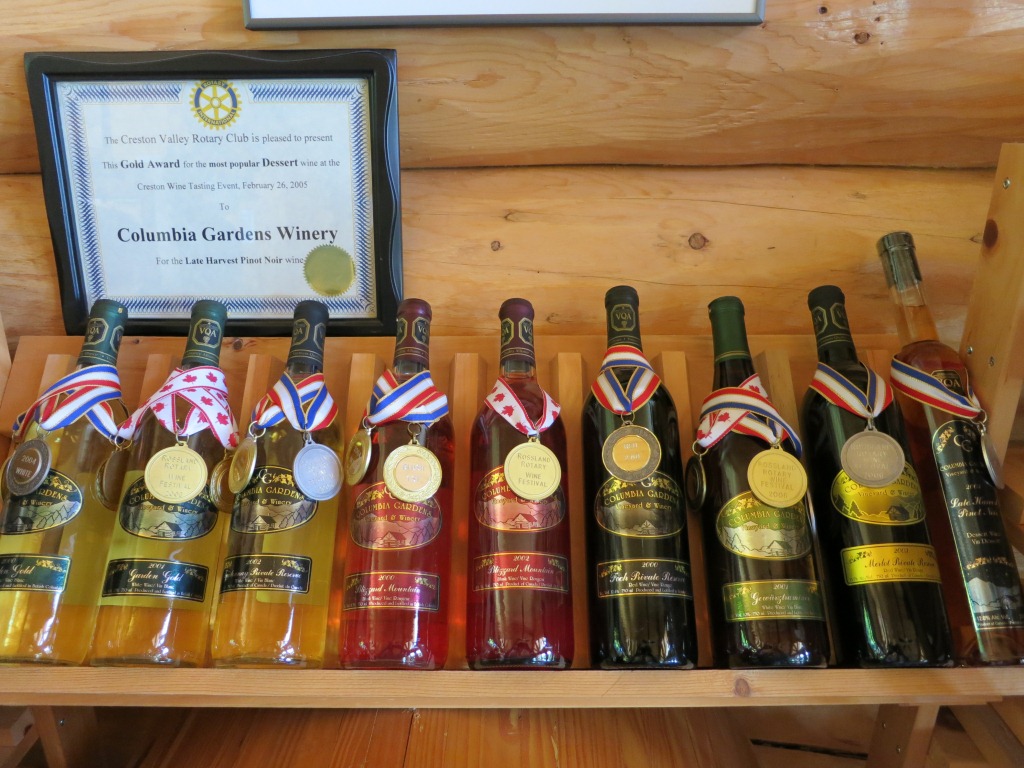
    It was then off to a nearby winery for lunch.  This is not really a wine producing region...at least not yet, but the lunch was delightful looking out over the vineyards. A second winery is being contemplated, although I should add that this one is for sale...with about 94 acres of land (all in the ALR) and a number of structures.

    Colombo Lodge: Italian Heritage
    After lunch Mike Martin and I set off to see Trail's Italian Heritage at a community plaza and lodge building housing hundreds of artifacts.  There were pictures of a younger Bruno Freschi and Thomas D'Aquino along with famous hockey and baseball players and other Italian-Canadian dignitaries. These included numerous past mayors including Sandy Santori, who went on to become an MLA and Cabinet Minister.  Sandy had joined us at some previous events and I must say....he has changed!

    Star Grocery
    From the Colombo Lodge we went over to meet Pasquale Amantea who for the past 40 years has operated Star Grocery, a well-known purveyor of Italian foods, meats, sausages and wine and beer supplies.  Pasquale greeted us with a large platter of Italian meats and cheeses which we took down to his basement where bottles of his home-made wine were breathing.  It was wonderful...especially since I hadn't eaten for almost an hour and a half!  But at 3:15 the Mayor arrived to let us know we had to leave...they were waiting for us at the new covered Bocce facility.

    Bocce
    Four wonderful older Italian-Canadian men challenged the Mayor, Mike and me to a game. I was particularly charmed by Ozzie Lus (in the dark shirt), whose son Steve Lus works at CBC.  He tried to teach me the game, but I was a terrible student...perhaps because of the wine from lunch and Pasquale, and the beer being served during the game.
    What a wonderful way to spend a Friday!

    After a brief break, it was off to Colander Restaurant, a Trail institution for dinner with the Mayor and Mike and some of the people I had met during my brief visit. Lisa from the Royal Theatre was there (after leaving to start the film at her theatre) with her husband Jason, a local firefighter. It became apparent that everyone was very proud of Trail and eager to see further revitalization of the downtown area.  To my mind, it is just a matter of time, although there is no doubt that community leadership is required, along with some developers to take some initiative and make things happen.

    My sense is that the time is ripe for some new infill developments providing apartments for seniors and others who want to live within the pedestrian scaled downtown.  While no one has done this before, that's no reason to keep delaying.  I suspect that in the coming months, the Mayor and Council will take some initiatives to demonstrate the potential demand and development opportunities.

    Throughout my two days here I have been very impressed with the sense of civic pride. There is a good reason why so many people have left, only to return. Trail has a very special sense of place and community.