Tuesday, June 19, 2012

Cruising down the river on a Saturday morning...

I was a bit surprised when Mike Martin mentioned that my hosts had arranged a boat trip before my 9:55 flight on Saturday morning. But that's because I was thinking like a resident of Vancouver, and not a visitor to Trail. I mean, let's face it.  In Vancouver I would have to leave for the airport an hour and a half before the flight...that would have meant a very early start.  But not so in Trail!
Don Freschi's boat (yes, Bruno's cousin) was docked about five minutes from my hotel.  We then toured up and down the river for about an hour, past the town centre, the Teck operations, and many waterfront homes. While I was noticing all the properties that I thought were ripe for redevelopment, Don was pointing out some good fishing areas. I subsequently learned that people weren't joking when they said he was a very experienced fisherman.  In fact, Don has been the host of a TV show Sport Fishing on the Fly www.sfotf.ca and is featured in many sport fishing videos. I hope he managed to get a few hours of fishing in after we left.
We docked up river and I joked how nice it would be to have a hot coffee.  The words were no sooner out of my mouth when an SUV pulled up and out came our hosts with a tray of Tim Horton's coffees and donuts/muffins. While everyone seemed quite relaxed, I was getting concerned about missing my flight. Finally I asked Betty how far we were from the airport and how long it would take to get there.

"We're at the airport" she said with a smile!  Sure enough, we drove up the hill and there was the plane on the tarmac!

It did not take very long to get through security.  In fact, it didn't take any time to get through security.  It reminded my of the joys of flying before the era of removing belts, shoes, etc.

We said our goodbyes and I got on the plane.  No need to request a window seat or an aisle seat. The window seats were aisle seats.  The gentleman across the aisle asked the pilot about the day's in-flight movie. He said there was no movie today, but he and the co-pilot could provide a bit of theatre. We all agreed that wasn't necessary.

It turned out my fellow passenger was a surgeon who comes to Trail four times a year to help out. He told me that many of the doctors at the hospital enjoy living and working there since they are so close to skiing, golf, boating, fishing and can affordable beautiful homes they couldn't dream of owning in a big city. If they need more variety, they can get away for a weekend...they are close to Spokane, Kelowna and Vancouver (under $300 return incl taxes)

It reinforced my earlier impressions that while those of us who grew up in big cities can't imagine living in a small town, there is much to commend it.  Especially in a place like Trail where there are many good jobs and other employment opportunities.  Of course there are many aspects of big city life that are missing; the sidewalks are not as busy; there are fewer transportation options...Trail's bus service ends in the early evening, and there are few taxis, making it difficult to enjoy too much wine at dinner unless there is a designated driver.

However, these shortcomings can be offset by the sense of community and connectiveness...things that the Vancouver Foundation has discovered are often missing in a big city/region like Vancouver.  Perhaps that is why so many younger people who left Trail to go to school or work away, have decided to move back. Hopefully, over time they will become more involved in community politics and leadership and help bring about some necessary changes....such as a revitalized downtown, better transit and taxi service. 

In so doing, they may well achieve the best of all worlds. But for the time being, I'm sure they, like many longtime residents, are very happy with and proud of their community. It's not only a great place to live...it's also a great place to visit!


Friday, June 15, 2012

A most eclectic day in Trail!

It's been a long time since I had such an eclectic, varied and interesting a day as I had today in Trail.

It started with a breakfast with members of the Family Action Network which is part of the Health and Environment Program being undertaken by Teck and various health related professionals. Their goal is to assess the health of children in Trail and promote healthy lifestyles. I was interested in whether kids growing up in a community like Trail are indeed more or less healthy than those growing up in a city.  More specifically, what if any is the impact of the nearby Teck operation? Do Trail children benefit from the very active sports programs that people pursue here, and the fact that they can safely walk to school?  This is, after all, BC's number one Sports Town!

While we didn't reach any conclusions, I personally thought that what kids ate and drank, and whether they walked to school, participated in sports programs and the like, would likely have a greater health impact than living in a town with a smelter. But hopefully, research will be carried out to assess whether this is correct.

Following breakfast it was off to celebrate the completion of a new lighting project for a major mural on the side of the Memorial Centre at the entrance to the town. One of the revitalization projects suggested in the Downtown Plan is the lighting of the adjacent bridge. I hope this does happen since I think it would be a great initiative that could contribute to a more vibrant downtown area.

Tour of Teck operations

Following breakfast I was given a limited tour of the Teck operation. I say limited since the facility is immense and a full tour would likely take about a week.  I was struck by a number of things. While this was once the largest operation of its kind in the world, it is now one of the largest. Almost one and a half billion dollars has been spent on upgrading the facilities to meet new environmental standards and best practices.  New technologies are resulting in significant reductions in emissions. The company is now actively involved with E-Waste recycling for end of life electronics, amongst many other things.

While the site looked like a desolate wasteland in the 1930's this is no longer the case today. The surrounding area is very green, and Trail has won two national Communities in Bloom awards, in part as a result of monies invested by the company.

Trail is a company town and in many cases 5 generations of a family have worked at Teck and Cominco. The workforce is aging and many are retiring annually.  Interestingly, about 70% of retirees are staying in Trail and about 100 new employees are signing on every year.  While some are locals who left and returned, others are coming from other places.  The are coming for well-paid union jobs, and this should result in an increased demand for housing.

5N Plus Trail Inc
This is a local company that was purchased by a Montreal firm in 2009. As one of the founders said to me, we were a bunch of Trail boys trained at Teck who are now in a very unique and sophisticated business creating semi-conductors for thermal imaging.  They are one of only two companies in the world that do what they do!

As I toured their new and enlarged facilities I wished that I had paid more attention in chemistry class. I had very little understanding of what the company was doing, but it all seemed very innovative and green. I was told the company is dedicated to advanced semiconductor processing, metals purification, metals recycling and the development of a solar module recycling facility.  It seemed like a modern day version of what Teck was doing, although it too has modernized in recent years.  But it seems that this company is operating here because of its relationship with Teck.

KC Recycling Ltd.
I then went down the street to visit the largest lead-acid battery recycling plant in Western Canada. Residual plastics from the batteries are converted into tiny pellets and the lead is processed at the Teck operation.

The company also prepares end-of-life electronics (e-waste) for processing and metals reclamation. It was fantastic to watch all the TV's, computers and other electronic equipment being shredded and sorted to recover steel, silica, aluminum, copper and circuit boards. Again, materials are sent to Teck for final metals recovery.

Thinking about the amount of e-waste we are all generating in our lives, one could not help but appreciate the potential for this business.  Next door to KC Recycling was Toxco Waste.  Time did not permit a visit, but I learned that this is where my Prius Hybrid battery will likely go when it no longer functions. While the company waits for my battery, it recycles lithium batteries. It is apparently the largest facility of its kind....in the world!

Waneta Dam Expansion Project
I was then off to get suited up to visit the largest dam construction project currently underway in BC. It is costing 900 million and will one day provide additional power for the Teck operation, and other needs. It's not actually a new dam, but an expansion of one that is already in operation. I had never heard of this project but it was quite fantastic to watch.  A lot of rebar and concrete....to say the least.

Columbia Gardens Winery
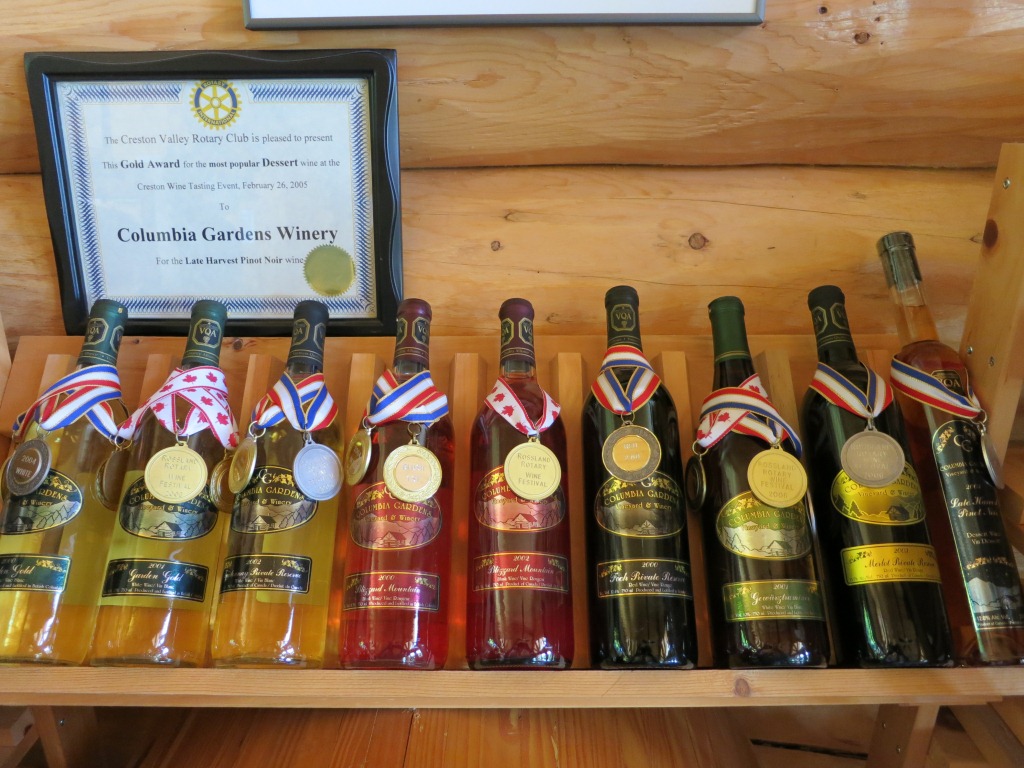
It was then off to a nearby winery for lunch.  This is not really a wine producing region...at least not yet, but the lunch was delightful looking out over the vineyards. A second winery is being contemplated, although I should add that this one is for sale...with about 94 acres of land (all in the ALR) and a number of structures.

Colombo Lodge: Italian Heritage
After lunch Mike Martin and I set off to see Trail's Italian Heritage at a community plaza and lodge building housing hundreds of artifacts.  There were pictures of a younger Bruno Freschi and Thomas D'Aquino along with famous hockey and baseball players and other Italian-Canadian dignitaries. These included numerous past mayors including Sandy Santori, who went on to become an MLA and Cabinet Minister.  Sandy had joined us at some previous events and I must say....he has changed!

Star Grocery
From the Colombo Lodge we went over to meet Pasquale Amantea who for the past 40 years has operated Star Grocery, a well-known purveyor of Italian foods, meats, sausages and wine and beer supplies.  Pasquale greeted us with a large platter of Italian meats and cheeses which we took down to his basement where bottles of his home-made wine were breathing.  It was wonderful...especially since I hadn't eaten for almost an hour and a half!  But at 3:15 the Mayor arrived to let us know we had to leave...they were waiting for us at the new covered Bocce facility.

Bocce
Four wonderful older Italian-Canadian men challenged the Mayor, Mike and me to a game. I was particularly charmed by Ozzie Lus (in the dark shirt), whose son Steve Lus works at CBC.  He tried to teach me the game, but I was a terrible student...perhaps because of the wine from lunch and Pasquale, and the beer being served during the game.
What a wonderful way to spend a Friday!

After a brief break, it was off to Colander Restaurant, a Trail institution for dinner with the Mayor and Mike and some of the people I had met during my brief visit. Lisa from the Royal Theatre was there (after leaving to start the film at her theatre) with her husband Jason, a local firefighter. It became apparent that everyone was very proud of Trail and eager to see further revitalization of the downtown area.  To my mind, it is just a matter of time, although there is no doubt that community leadership is required, along with some developers to take some initiative and make things happen.

My sense is that the time is ripe for some new infill developments providing apartments for seniors and others who want to live within the pedestrian scaled downtown.  While no one has done this before, that's no reason to keep delaying.  I suspect that in the coming months, the Mayor and Council will take some initiatives to demonstrate the potential demand and development opportunities.

Throughout my two days here I have been very impressed with the sense of civic pride. There is a good reason why so many people have left, only to return. Trail has a very special sense of place and community.

Explore your TRAIL: More than you imagine!


I first came to Trail in 1974 when I was developing senior citizens' housing around the Province with CMHC. But I never had an occasion to come back until this week.  I won't wait 38 years before I come back again!

I am here for a few days at the invitation of Mayor Dieter Bogs to whom I was introduced by Mike Martin, the former Manager of Teck Trail Operations, the largest employer in the region. I was introduced to Teck two years ago when the company was seeking advice as to how best contribute to the revitalization of the City's downtown. Now that a new Downtown Plan has been produced, I am here, not as a paid consultant, but as someone with an interest in towns and cities who enjoys sharing lessons learned from around the world.
Trail is a very interesting and authentic place. While there is some confusion as to the exact population it's somewhere in the order of 7500. It is called a city, but feels like a small company town, because to a large extent, that is what it is, with the massive 450+ acre Teck operation literally overlooking the city.

Ask most Canadians what they know about Trail and if they are old enough, they'll mention the Trail Smoke Eaters, who won a World Hockey Championship in 1961. (I'm told that a Smoke Eaters hockey jersey is a 'must have' for any collector of sports memorabilia.) They may also tell you they've been told it has a grey, somewhat polluted industrial landscape.

That's what I assumed too.

Was I ever wrong. I assumed that like many other industrial towns across Canada, there would be an industrial odour hanging over the town. There isn't. Not at all. In fact, when visiting a small downtown Teck Interpretative Centre designed to educate people about the operations, I was struck by a hand written comment on a notice board that said "Thanks for the breath of fresh air!"

And while there is white stuff billlowing from the many industrial stacks... it is essentially steam, not smoke!  But then again, the Trail Steam Eaters doesn't quite sound the same!
During my first day here I had a number of other surprises. For one thing, the town has successfully participated in the Communities in Bloom competition  http://www.bccommunitiesinbloom.ca/ and is a two time national champion This year, Trail is participating in the international competition and during my tour around the town I was shown many of the works underway in advance of the judge's visit next month. Trail now participates in the program annually, and the impact of the program can be seen all over town.

Outside the hospital, (yes, there's quite a large hospital here) volunteers were planting ornamental flower beds. I was impressed to learn that many of the new hospital facilities and equipment at the hospital have been donated by local companies and individuals. For example, Kootenay Savings, the local Credit Union was the lead sponsor for a new Helipad that was recently completed near the hospital's front door.

Trail's participation in the Communities in Bloom program was the result of a $250,000 in seed money (pun intended!) from Cominco about 10 years ago.  Since then, the program which involves much more than just planting flowers has led to the painting of numerous colourful murals, creation of neigbourhood associations, neighbourhood signage, and other volunteer beautification intiatives.

Communities in Bloom is a wonderful program that I first learned about when I visited Fairhope Alabama which once won the National Cities in Bloom competition, and came third in the Nations in Bloom competition. (In Ireland, the comparable program is known as the Tidy Towns Program!)

Another surprise was the number of people I met who were born and raised in Trail, but left, only to return. As Steve Lus, the well known CBC Early Edition newscaster tweeted to me, many return because of strong family ties and job opportunities. The strong family ties may be related to the very large Italian-Canadian population in Trail. Indeed, many of the town's prominent 'exports' such as Bruno Freschi and Ken Georgetti have Italian backgrounds.

One of the town's more prominent families is the Ferraro family. It runs a beautiful supermarket called Ferraro Foods which felt like an upmarket Italian version of Stong's Foods in Dunbar!  I am told there is another excellent Italian food market and some good Italian restaurants. Tonight I'm off to Colander Restaurant, Frances Bula's favourite spot in town.  Frances agrees with me that Trail has a special quality and yes, authenticity that far too many BC communities have lost.

Another surprise was meeting some young urban professionals who have moved to Trail to start up new businesses. One example was a very stylish young lady named Lisa Milne who along with her husband has purchased and beautifully restored the Royal Theatre.  Not only has she installed digital 3-D equipment at a cost that will no doubt take years to recover, but she has arranged for live feeds to the Metropolitan Opera in New York on Saturday mornings and the Bolshoi Ballet. Unbelievable! Does anybody do this in Vancouver?

My first day in Trail destroyed a lot of myths...for example, it's much greener than I expected... but I must now head off to my first of many appointments for the day...but suffice it to say, there's much more I want to write about this very special place.

Friday, June 8, 2012

Housing Form and Design: my contribution to the Mayor's Affordable Housing Task Force

Yesterday I joined Bruce Hayden and Patrick Condon at SFU's Noon Time Conversation Series to discuss whether there is a need for alternatives to the glass high-rise tower for Vancouver.  All three of us suggested that while there is a place for towers (well, two out of three were more supportive of building towers, right Patrick?) we all agreed that there is both a place and need for alternatives, especially those that can produce more affordable housing. These include fourplexes, sixplexes, townhouses, stacked townhouses, wood-frame apartments up to six storeys, and mid-rise buildings, both 'set on their own grounds', and with zero side yards.

This prompted me to suggest that some of the audience might be interested in the report that I prepared for the Mayor's Affordable Housing Task Force that examined these options and where they could go, and what changes might be required to facilitate them. In essence, I suggest ways to encourage more redevelopment along arterials (yes I know they are busy, noisy and dusty) but also propose a NEW TRANSITIONAL ZONE that might be established between the arterials and single family streets, and around transit nodes and community facilities.

This morning I was reading Frances Bula's Blog www.francesbula.com and came across a number of discussions regarding building form and density. This has prompted me to share a link to my report, noting that in the coming weeks, the Task Force will be issuing its final report. Then a full discussion will hopefully begin.

So far I have received one formal letter from a neighbourhood organization that criticized me and my report....It didn't even start off by saying how much it appreciated the effort that had no doubt been put into drafting the report....it just jumped straight into the concerns :-)  but I will look forward to hearing what others have to say.

Here's the report   http://vancouver.ca/ctyclerk/civicagencies/housing/PrelimRptFormDesign.pdf


Monday, June 4, 2012

SFU City Conversation: City of Glass Forever?

From Gordon Price's Pricetags blog...

I am flattered to be invited to participate in this...I'm sure there will be lots of room if you're downtown Thursday around noon...

First Thursday City Conversation: City of Glass Forever?

May 31, 2012


1 Vote

New building types for Vancouver
Thursday, June 7
Time: 12:30-1:30 pm
Place: Room 1600, Harbour Centre, 515 West Hastings St.
Cost: Free
Vancouver’s picture-postcard look is of slender, glassy residential towers framed by water and mountains. Is that 25 year-old style now overdone? Does the city require different architectural types? The mid-rise character of Olympic Village is a first response to those concerns. But what else should Vancouver’s new buildings look like, and where should they be built?  Share your ideas in a City Conversation about Vancouver’s next look and feel with architect-developer Michael Geller; Bruce Haden, a principal of the prominent firm DIALOG; and UBC professor Patrick Condon.

From Canadian Mosaic.

Friday, June 1, 2012

EXPO 2012 Yeosu Vancouver Sun Homes away from Home


World’s fair offers visions of the future

Expo 2012 imagines underwater homes and self-contained communities in lakes and oceans

By MICHAEL GELLER, Special to the Sun June 1, 2012 3:02 PM
The Expo Town apartments do not have shared internal corridors. Instead, each pair of suites is served by an individual elevator and staircase.

The model of an underwater city on display in the Marine Civilization and City Pavilion at Expo 2012 Yeosu Korea seems too fantastic to ever be realized. But then, so did the prototypical automobile on display at the 1885 Antwerp Exposition and the television unveiled at the 1939 World Fair in New York.

Since the first world exposition was held in London’s Crystal Palace in 1851, many of the products we now take for granted around the home were showcased at world’s fairs. These included the elevator, the light bulb, the gramophone, the sewing machine and even the zipper.

Two years ago, more than 70 million people attended Expo 2010 in Shanghai. The theme was “Better City, Better Life” and visitors had the opportunity to witness future concepts in community planning and home design. They watched robots preparing meals in the kitchen and helping the elderly get in and out of bed in nursing homes. They saw community garbage being collected by robots and an underground vacuum system.

From now until August, a much smaller exposition is being held in the mid-sized town of Yeosu on Korea’s southern coast. The theme is “The Living Ocean and Coast” and the entire site is designed to form a model city that displays the low-carbon lifestyle we can expect in the future. Each of the theme pavilions demonstrates ways to achieve sustainable development by promoting an environmentally responsible use of the sea. Many of the international pavilions also present thought-provoking ideas, including the banning of non-biodegradable plastic bags in the United Arab Emirates pavilion and strategies for integrated waste management happening in Singapore.

If the ideas presented at Yeosu materialize in the same way as innovations from previous world expositions, we will not be dependent on fresh lakes and rivers for our water supply in the future. Instead, much of the demand may be met through the economical production of desalinated sea water. Energy needs will be satisfied in part by biofuels made from seaweed and other marine resources and new biodegradable plastics will be made from materials found in the sea.

Future town squares may be covered and animated by giant digital screens, similar to the spectacular 218- by-30-metre-wide LED screen located above the Expo site’s main street. The ever-changing colours and patterns include swimming whales comprised of photographs downloaded by visitors to the site.
We will travel in battery-powered low floor trams that do not require any overhead wires, similar to the Hyundai Rotem hybrid prototype on display. Cars will be powered by electricity or fuel cells.

Floating underwater houses will feature high-tech automation systems that adjust oxygen levels, air pressure and indoor temperatures. A desalination system will purify drinking water and a solar power generator will offer a self-supported energy storage system. Floating parks, harbours and resorts will result in entire self-contained communities in lakes and oceans.

While no one is living in floating communities at Yeosu, 6,600 people (1,800 from abroad and 4,800 from Korea) are staying in 1,442 apartments in the newly created Expo Town, which has its own temporary clinic, coffee shops, pubs, Internet cafes, fitness centres, laundry rooms and prayer rooms for Buddhists, Catholics, Christians and Muslims.

Expo Town offers Giga Internet, with a connection speed of 1Gbps, which enables download of a DVD movie in 10 seconds. The apartments also include a variety of state-of-the-art green features and will be converted into condominium, rental and time-share units after the fair.

The highrise apartment buildings at Expo Town are typical of Korean apartments, which generally differ from Vancouver highrises in that there are no shared internal corridors. Rather, a vertical module is formed by two suites served by an individual elevator and staircase. The modules are then linked together into large buildings and complexes.

As a result, every suite has windows facing in opposite directions, providing good light and cross ventilation. Moreover, residents can enjoy the sunrise in the morning and the sunset at night. While this arrangement results in additional elevators and stairs compared to the typical Vancouver building, the extra cost is offset by reduced corridor area and more efficient suite layouts.

Two Vancouver-area developments designed on the same concept are 1717 Bayshore Drive and One University Crescent at UniverCity. Many purchasers appreciate this arrangement since the suite layouts feel more like a detached house than an apartment. While one drawback is that only one elevator generally serves each apartment, I was told this is not considered a problem in Korea.

To make this design concept more economical in B.C., a Building Code modification would be desirable so that only one staircase need be provided for each vertical module, rather than separate staircases as required by current codes. Given the increased availability of fire resistant materials and sprinklers, this would seem a reasonable modification.

In addition to alternative building and suite layouts, the bathrooms in Expo Town apartments include two features generally not found in Vancouver developments. These are high-tech or “smart” toilets that offer heated seats, built-in bidets, and other features to enhance the bathroom experience. Fortunately, the first time I used one of these toilets, the instructions were in English; otherwise I would have had quite a shock! Apartment showers are also much more elaborate with multiple heads and adjustments, similar to what might be found in very high end homes in North America.

After enjoying Korean bathrooms for over a week, I wonder why these toilets and showers are not installed in new Vancouver area buildings. However, I suspect it is just a matter of time before a developer includes them in a project. Then we can expect them to become as commonplace as granite countertops!
Expo 2012 Yeosu is on until Aug. 12. 


More information can be found at http://eng.expo2012.kr/main.html
Michael Geller is a Vancouver-based architect, planner, real estate consultant and property developer. Additional information and photos of Expo 2012 can be found on his blog at www.gellersworldtravel.blogspot.com
© Copyright (c) The Vancouver Sun

EXPO 2012 Yeosu: Vancouver Sun Op-ED


Expo 2012: Where’s Canada?

The world came to Canada in 1967 and 1986, but our country is not participating in expositions elsewhere

By Michael Geller, Special to the Sun May 30, 2012

Expo 2012 has a theme of The Living Ocean and Coast, something that Canada should have a lot to contribute to, but we will not be there in Yeosu, Korea.
This summer, 105 countries are gathering in Yeosu, a mid-sized port city on Korea’s southern coast. They are participating in Expo 2012, an international exposition on the theme The Living Ocean and Coast. It is a sad irony that Canada, which has as its motto From Sea to Sea, is not among the participating countries.
Canada was one of the few major countries that declined Korea’s invitation to participate for economic reasons. Another was Greece. While one can appreciate why Greece chose not participate, it is very disappointing that Canada is not at the fair.

England also decided not to participate. Its absence is equally ironic since it was in England in 1851 that the world’s first exposition was held at the Crystal Palace under the title Great Exhibition of the Works of Industry of All Nations.

Over the subsequent 161 years, world expositions have provided wonderful opportunities for countries to showcase their accomplishments and contribute to the sharing of knowledge. They have been described as the intellectual equivalent of the Olympics. Many of the objects that we now take for granted were first introduced at world fairs: the steam engine, sewing machine and Morse Telegraph in London in 1851; the elevator in 1853 in New York; the telephone at the 1876 Philadelphia exposition; the gramophone in Paris in 1878; and the automobile at the 1885 fair in Antwerp Belgium.

The Eiffel Tower was the focal point of the 1889 exposition held in Paris and the world’s first Ferris wheel was the attraction at the 1893 Chicago World Fair which also introduced the zipper. In 1939, an invention that was to change the world was introduced in New York City — the television set.

World expositions have addressed many important themes. Many Canadians still remember Expo 67 in Montreal — Man and his World — which changed the world’s perception of Canada. Nineteen years later, what started off as Transpo86, a modest event to celebrate Vancouver’s 100th birthday, eventually became Expo 86 and changed the world’s perception of Vancouver.

There are many reasons why Expo 86 succeeded despite the many hurdles along the way. But part of its success can be attributed to the fact that we invited the world, and it came, including South Korea. This is one reason why Canadians should be embarrassed with Canada’s decision not to participate at Yeosu Expo 2012.

Some may agree with the government’s decision not to fund a pavilion, especially when there are homeless people on the streets and a multitude of other priorities having to manage without federal funding. Moreover, it is no longer necessary to travel to a place to see the latest invention. We now have the Internet to transfer information around the world.

However, just as there is value in world travel, attending trade shows and international conferences, there are significant benefits from participating in a world exposition. Some are tangible and can be measured in economic terms; others are less tangible.

As was the case at Expo 2010 in Shanghai, a World Fair is often the first opportunity for millions of people to learn about another country. This can result in tourism, educational exchanges and the potential for greater world harmony.

There can also be significant business opportunities. For these reasons, it was not necessary for the Canadian government to finance all the costs of a pavilion. Instead, it could have been a facilitator, fostering partnerships with the private sector, which is how the United States pavilions were funded at Shanghai’s Expo 2010 and Yeosu.

Expo 2012 Yeosu calls upon the world’s nations to preserve and protect the endangered ocean and coastal ecosystems. Sub-theme buildings examine climate and environment, marine industry and technology, marine civilization, and the marine life.

While the Yeosu fair is considerably smaller than the Shanghai fair, it does showcase Korea’s emergence as a major industrial and technological nation. International corporations such as Samsung, LG, and Hyundai offer fascinating ideas and concepts for the future and, not surprisingly, there are spectacular multimedia shows and visual effects. The Expo Digital Gallery, a 218-metre-long and 30-metre-wide LED screen covering the central concourse features digital whales created from visitors’ photos swimming through the ocean.

There are displays on desalination; proposals to create biofuels and plastics from seaweed and other marine resources; and models of floating homes and underwater cities. While some of these ideas may seem incredible, so did the elevator, automobile and television set when they were first introduced at World’s Fairs.

It is too late for Canada to be at Yeosu. And sadly, the federal government has backed out of supporting Edmonton’s bid for Expo 2017, which was to coincide with Canada’s 150th birthday. But I hope we will participate at Milan’s Expo 2015. After all, we would not dream of missing the Olympic Games. We should not be missing these intellectual Olympics either.

Michael Geller is an architect, planner, real estate consultant and property developer. For more information about EXPO 2012 Yeosu go to http://eng.expo2012.kr/main.html Additional information can also be found at www.gellersworldtravel.blogspot.com.
© Copyright (c) The Vancouver Sun