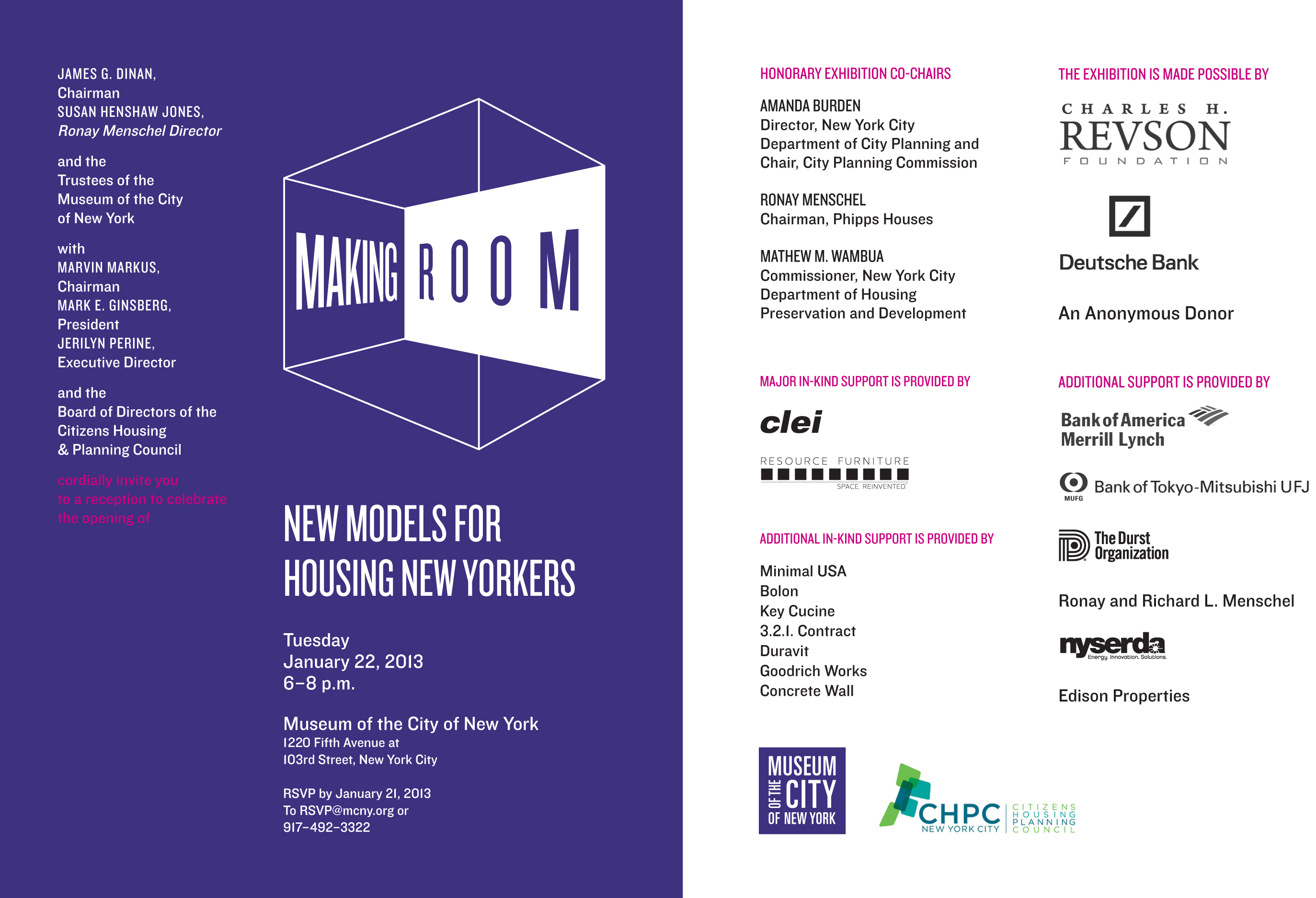
Tuesday, January 22, 2013

MAKING ROOM: New York Museum Exhibits UniverCity's Suite within a Suite

MakingRoom-1
Last year, I received an email from the Museum of New York requesting approval to include a project from UniverCity in a special forthcoming exhibit on smaller housing ideas. Today, the exhibit is opening but sadly, too many local commitments prevented me from attending the opening reception.

My contribution is the suite within a suite...which was included in a number of projects at SFU's UniverCity. Just as some single family houses have a basement suite to provide affordable housing and help pay the mortgage , these two and three bedroom suites had a 'lock-off' suite that could be rented out or ultimately incorporated into the balance of the unit. I saw this as a way for households to afford the larger unit that they might ultimately need by renting out a portion. 

It's like a 'basement suite in the sky' or as the Province newspaper dubbed it, 'A mortgage helper in the sky'

In 2007, this idea was selected by the Urban Land Institute for publication given its innovative approach. I am delighted that the organizers of the Museum exhibit learned about it and chose to include it in the show. I'm just sorry I can't be there to attend the opening and see the other ideas on display.  Here's some more information about the exhibition.

MAKING ROOM is a CHPC initiative  that brings together cutting-edge housing policy and demographic research with pragmatic policy recommendations that would help to develop some brand new, legal and safe housing options for 21st century New York City.
We are delighted to announce that these cutting-edge ideas will now be showcased at the Making Room Museum Exhibition, opening on January 23rd at the Museum of the City of New York. To attend the exclusive exhibition reception, taking place on January 22nd at 6pm, email your name to RSVP@mcny.org.
 

Over the last three years, CHPC has been dedicated to exploring new housing ideas so that New York City can Make Room for its whole population.

We developed a unique data model  to examine how New Yorkers are being accommodated in housing today. The unexpected finding was a predominance of non-traditional households struggling to fit themselves into a housing stock designed and built for traditional households. New trends in immigration, demographics, technology, and the economy are reshaping how people live.

Almost half of New York adults are now single, creating a need for new types of living arrangements. Only 18% of our housing is occupied by a nuclear family (two parents and children under age 25). Nevertheless, New York City housing regulations continue to encourage homes and apartments designed for nuclear families; single family units with mostly two and three bedrooms. With unmet demand for more diverse housing choices growing, especially for the millions of single adults, the Making Room project revealed that more and more people are turning to the improvised housing market, often living in illegal and dangerous situations.


Sunday, January 13, 2013

Goodbye Dr. Tomorrow. In Memory of Frank Ogden

I woke up this morning and checked Vancouver Sun headlines only to discover that a man for whom I had the greatest admiration had passed away.  Frank Ogden....Dr. Tomorrow. I first met him when I started working in Coal Harbour and like many others, was absolutely fascinated when he invited me onto his houseboat and gave me a tour of his floating laboratory.

I often thought of him, especially when reading a book, since as the author of The Last Book You Will Ever Read, he was truly ahead of his time.

So often in life we think of people but don't get in touch with them. However, a couple of years ago I decided to try and track down the man I knew as Dr. Tomorrow to see if he was still alive and if so, what he thought of how the world had changed. I found him, and below is our initial exchange of emails:
Michael Geller <michaelarthurgeller@gmail.com>
18/11/2009

to Dr.Tomorrow

I remember you; do you remember me?

Frank Ogden, as the world keeps changing, I often think of you.  We met many years ago in Coal Harbour and I have often thought about the things you said to me at the time.  I am a Vancouver based architect and property developer involved with the redevelopment of the Bayshore property and a number of other developments around the city at SFU, Steveston, and Kerrisdale.

I thought of you this morning and decided to see if you are still in Vancouver and whether you take visitors!  If so, I would love to hook up again.  cheers


--
Michael Geller B.Arch, MAIBC, FCIP
 778 997 9980   www.michaelgeller.ca
www.gellersworldtravel.blogspot.com

FORGET THE MICHAEL GELLER?? IMPOSSIBLE.

HI MICHAEL,
THANKS FOR YOUR E-MAIL.

THIS ATTACHMENT IS THE FIRST "E-BOOK #1".  I  HAVE 15 MORE IN A PACKAGE THAT IN ITS GUTENBERG FORMAT SOLD FOR $150.00  I NOW SEND IT OUT FOR JUST $10.00 ALL IN THE DR TOMORROW LIQUID PIXELS & LIGHT FORMAT.  READ IT AND IF YOU WISH YOU GET THE OTHER 14 BOOKS JUST AFTER YOU TALK TO PAY/PAL.

I RECENTLY SOLD MY HOUSE BOAT AS A "FLOATING HOME" BY CHANGING THE NAME.  SAVED THE PURCHASER (A YOUNG 33-YEAR OLD LAWYER) $14,000.  HE MADE AN OFFER I COULDN'T REFUSE.
IT WAS TEN TIMES WHAT IT COST ME TO BUILD.  AND, THAT'S AFTER LIVING IN IT FOR 35 YEARS !

I MOVED INTO A RESIDENCE I BOUGHT 10 YEARS AGO, WHAT I CALL MY "RIVER COTTAGE" (ON THE BANKS OF THE CAPILANO) IN WEST VANCOUVER.  COME OVER IF YOU WISH.  THE ADDRESS IS 479 RAINDANCE CRESCENT, WEST VANCOUVER, V7P 1C3.  PHONE FIRST. 604 688 7103.

FOR THE PAST TWO DECADES I HAVE BEEN MAKING 700 GLOBAL PRESENTATIONS REGARDING HIGH TECHNOLOGY, COMMUNICATIONS, SOCIAL & ACCELERATING CHANGE. WEBSITE: drtomorrow@shaw.ca

HOWEVER I AM STILL JUST A KID AT 89.

D R.  T O M O R R O W
DISPATCHES FROM CYBERSPACE
C O M M U N I C A T I O N  P L U S
 F R A N K  O G D E N

ELECTRONIC SIGNATURE/AUTOGRAPH        & ® & ©
For the next couple of months I received regular dispatches from cyberspace!  While I was happpy to be on his short listserve, my inbox started to fill up on an almost daily basis! I just didn't have the time or energy to keep up with him. However, I checked this morning and I still have many of his missives that I will review. 
Of course I now regret that I did not go and visit him in his 'river cottage'. But I am glad that I did reconnect if only to discover that he never lost any of the energy and creativity that made him one of the most remarkable people I have ever met in Vancouver.  Goodbye Dr. Tomorrow.

Monday, December 31, 2012

10 Housing and Community Planning Predictions for 2013~Vancouver Sun


Housing, transportation will be hot topics

Opinion: Reduced parking requirements, the rise of car sharing and the need to increase dwelling density will be on the minds of many in 2013

By Michael Geller, Special to The Vancouver Sun December 28, 2012

Vancouver’s laneway program will be adapted by other municipalities.
As we approach a new year, it is always interesting to speculate on what might happen, especially on hot topics like community planning and housing. While I am reluctant to predict whether prices will go up or down, or whether the Olympic Village will sell out by year end, here are 10 things I do expect in 2013, in alphabetical order. 

.
1.  Car sharing and reduced parking requirements: With the success of Car2go, Modo and Zipcar, an increasing number of people will realize that car-sharing can be a convenient and cost-effective way to get around. Just as the popularity of fax machines increased as more people acquired them, the same will hold true for car-sharing. Increased program participation will encourage more municipalities to reduce parking requirements, with the attendant benefits of greater housing affordability and reduced congestion and pollution.

 
2. Depreciation reports: By the end of 2013, every strata corporation in B.C. must complete a report on the physical condition of their condominium, along with a financial plan to complete the necessary repairs. I expect this to lead to shock and dismay as owners, especially of older condominiums, discover that they cannot afford to repair their homes. In some instances, owners will discover the cost of repairs is greater than the value of their improvements. There will be widespread calls for government assistance.
3. Fee-simple row houses: As a result of a May 2012 legislative change, it will now be easier to get approval in Vancouver for individually-owned row houses that are not part of a condominium. Consequently, some new fee-simple projects will get underway in 2013 with a high level of market acceptance. Eventually, this will become the preferred tenure arrangement, and some condo owners who hate dealing with their strata council will investigate whether they can convert their development to fee-simple ownership.

4. Laneway and coach house programs: Inspired by the relative success of the Vancouver laneway housing program, other municipalities around B.C. will implement similar programs. While some may insist on the modest sizes and rental tenure required in Vancouver, others will allow greater regulatory flexibility to preserve smaller, older homes and offer more affordable home ownership.

5. Micro suites: The market success of recent projects in Vancouver and Surrey offering very small apartments for sale and rent will encourage other Metro municipalities to allow small suite developments. While neighbours will brand them unlivable, new renters and buyers will be delighted with their smaller, affordable homes, thanks in part to municipal approvals for reduced parking.

 
6. Modular housing: As more and more people watch videos of a 30-storey Chinese building being erected in 15 days using modular building technology, there will be increased interest in this type of construction in B.C. There may even be renewed interest in my 2009 proposal to use relocatable modular units to create affordable housing on parking lots and other vacant sites awaiting redevelopment around the city. (See my blog: tinyurl.com/bs7ze2j)

7. Regeneration of older social housing: While we await a construction start on the Little Mountain property, there will be increased public discussion regarding the future of other older public and social housing projects. As agreements with CMHC and the province approach their end, so will operating subsidies for lower-income households. Moreover, significant funds will be required for much-needed repairs to many projects. This will lead to calls for ongoing government support.

8. Replacement rental housing: As highlighted by a recent Vancouver Sun column by Don Cayo, Vancouver’s rate of change bylaw has protected renters in older apartment buildings. However, it has done little to create much-needed rental units. Moreover, many older buildings are deteriorating, in part because those landlords who did upgrade properties with corresponding rent increases often found their names plastered on the front pages. To address the situation, housing experts will publicly advocate for provincial and municipal policy changes, with little success.
9. Smaller houses on smaller lots: While many aging boomers will chose to downsize into a row house or apartment, others will prefer a smaller house or smaller lot, ideally close to where they are living. Inspired by the success of attractive cottage-style developments by Ross Chapin, a few small house infill developments will finally get underway during the coming year.
10. Transit funding: What many considered the hot civic affairs topic of 2012 will continue to be a major concern in 2013. While a segment of the population will object to any tax increases to support public transit, others will realize that a more comprehensive user-pay system is preferable to selective bridge tolls and funding tied to property taxes. There may even be calls to bring back George Puil’s once-hated vehicle levy.
In conclusion, none of these ideas are new. However, as the demographic profile of Metro changes, along with an increased awareness of the need for a more sustainable lifestyle, ideas that were once only talked about or considered fads will gain greater currency in 2013. Of course, change will happen slowly, but I do predict that by the time I sit down to write 10 predictions for 2014, we will have made progress on most of these items.
Happy new year.
Michael Geller is president of The Geller Group and Adjunct Professor at the Simon Fraser University Centre for Sustainable Community Development.
© Copyright (c) The Vancouver Sun

Monday, December 24, 2012

A 2013 Christmas Present for Vancouver's Homeless

Today I received an email from rental housing activist Tom Durning describing an innovative solution to house some of Los Angeles' homeless.http://www.latimes.com/news/local/la-me-skid-row-housing-20121216,0,1039440.story

It reminded me of a proposal I made to the Province and the City of Vancouver back in 2008 and 2009 following a study I undertook in conjunction with architects NSDA with funding from BC Housing. Our proposal was to create a stock of affordable modular units that could be set up for a period of time on a site, and subsequently relocated. Just like school portables are often used.

At the time, the proposal received a lot of media coverage but didn't go anywhere, in part I'm told, because neither Gordon Campbell nor Rich Coleman liked the idea of housing people in 'containers'.

The fact is, these weren't containers...they were purpose built prefabricated modular units that could be set up on a private property and relocated after say three years or more once the property was approved for redevelopment.

Others objected to the proposal because on a cost per square foot they claimed they were not much cheaper than permanent housing. Well, that might be true...except the units were planned to be much smaller and permanent housing solutions in Vancouver often cost significantly more than they should....in the order of $300,000 a unit. or up to $1000 a foot for projects like the Pennsylvania Hotel.

Relocatable modular units would cost less than one sixth of this amount, and take significantly...let me repeat significantly less time to construct.

Others pointed out that there's nothing more permanent than a temporary solution. I agree. But by placing these units on private property, they would ultimately be relocated...just like the community garden at Davie and Burrard. It won't be there five years from now!

Below is a presentation I made to the DTES community at the Carnegie Centre in which I suggested that we use the parking lots of the Drake Hotel for this type of housing.  Sadly, it did not proceed...meanwhile the facilities at the Drake have remained unused...and I don't believe we're much further ahead on a permanent redevlopment of that site.

So here's my proposed Christmas present to Vancouver's homeless. Let's try a demonstration project in 2013 to test out this idea. I am confident that while it is not THE answer to housing the homeless...it is another solution that could dramatically help many people by moving into something that's much better than a shelter, at a relatively modest cost.


Finally, here's a description of the proposal that was published on the ThinkCity website and a Vancouver Sun commentary by my colleague Bob Ransford whose judgement is regarded highly by many of us in the Vancouver housing and development community.

http://www.thinkcity.ca/node/162

http://www.househunting.ca/story_print.html?id=4f4d087d-e550-4a02-8d44-d6796cbb4f52&sponsor=

As we approach a new year, with a 2015 goal of ending street homelessness, I hope that the City and Province will take another look at this idea so that we might create a demonstration program by next Christmas Eve. What a wonderful Christmas present that might be for many Vancouver residents currently in shelters or on the street.  Merry Christmas