Wednesday, May 13, 2015

Opinion: Planners alarmed at Vancouver city hall contempt Vancouver Courier April 15, 2015


Last week, an unprecedented meeting took place behind closed doors at the UBC School of Community and Regional Planning. In attendance were former City of Vancouver planners, professors, planning consultants and associated professionals. I was one of them. They had gathered because of a shared concern over a number of recent Vancouver development approvals and what they saw as a diminishing respect for the importance of urban design and city planning within city hall.
 
“The respect for planners and planning is gone. Urban design is too often seen as a luxury or a constraint rather than a prerequisite for a well-planned city,” noted one of the participants.
Attendees also shared a desire for a better city plan to guide future development decisions. While some saw this as updated neighbourhood plans, others believed it was time to prepare an overall city plan, something which most cities have.

During the two-hour discussion, a number of related concerns were expressed. These included what many described as an increasing lack of trust between the architectural and planning professions and the senior administration at city hall. One attendee observed that it is heartbreaking to see many of the urban design principles that have made Vancouver internationally famous, now being ignored or sometimes viewed with contempt. “Building design is no longer as important as it used to be.”

He criticized the growing practice of negotiating project designs and Community Amenity Contributions (CACs) behind closed doors in the mayor’s and city manager’s office. Examples included 1403 Comox, Kingsway and Broadway, 70th and Granville, 900 Block East Hastings, Shannon Mews, Oakridge, and the Brenhill project.

One former city planner noted that in the past it was important to establish a building’s overall size and density before calculating the CACs. Now the city has become so addicted to CAC payments, the money and social benefits too often determine the building design.

Some lamented how many older planners have left the city, sometimes due to retirement, but also due to what they described as a toxic working environment. As a consequence, the city is losing its “institutional memory” essential for future planning.  One respected voice observed the city has a vision, namely to increase the supply of affordable housing. But unfortunately, this seems to be driving too many poor planning decisions.

Others decried the “us and them” relationship that seems to have developed between city hall and the neighbourhoods. “Consultation is a charade,” he said, adding too often the city staffer taking meeting notes decides what he wants to be said, rather than what was said.

At the conclusion of the meeting, the discussion turned to the Brenhill project which proposes an almost six-fold increase in density compared to the zoning. While all acknowledged the proposal results in replacement social housing and rental units, the consensus was that this building was much too big for the site.  Apparently this had been confirmed by the initial Urban Design Panel (UDP) review which rejected the design 7-0. After some very minor changes the project returned to the UDP. This time the vote was 5-3 in favour; however some panel members privately complained they felt coerced by the planning department to change their vote.

This project was scheduled to go to a new public hearing Tuesday night. Customarily it would go to the UDP before public hearing. The group therefore decided to send a letter to council urging proper due process by referring it back to the UDP before final consideration.

While it was acknowledged council will make the final decision, those present thought it was particularly important that the UDP have the opportunity to offer its comments to council, especially in this particular instance.

While I, like everyone present, did not agree with everything that was said, I share many of the concerns articulated. Regardless of the final decision on the Brenhill project, we need to have a broader public discussion on just how far city planners should depart from accepted zoning, planning and urban design guidelines to achieve the administration and council vision of more social and affordable housing.
 
I hope this conversation will continue, but not behind closed doors.
- See more at: http://www.vancourier.com/opinion/planners-alarmed-at-vancouver-city-hall-contempt-1.1823383#sthash.I1PUkNUD.dpuf

Opinion: Suggestions for a friendlier Vancouver Vancouver Courier April 8, 2015


Do you know your neighbours?

In last week’s column, I wrote about a talk I was giving that evening at SFU called “Twelve Great Ideas for Vancouver from Around the World.” I was gratified by the turnout, but even more pleased with the discussion that followed.

Of the 12 ideas presented, one that generated considerable interest was the need to make Vancouver a friendlier city. Many in attendance commented on how difficult it can be for newcomers to make friends. Suggestions were offered on how to design friendlier apartment buildings, including putting a residents’ lounge near the entrance, rather than in some leftover hidden space.

One speaker suggested that instead of having Family Day in British Columbia, we should have Neighbour Day, when neighbours could meet in one another’s home or at a block party. Far too many of us do not greet neighbours when they move in, and after a while there does not seem to be a good justification to introduce ourselves. I facetiously responded we’ll all get to know one another when the earthquake hits us, and we’re dependent on each other for survival.

I also suggested, since I doubt the premier will replace Family Day with Neighbour Day, that we might designate an arbitrary date, say the third Saturday in May, as Neighbour Day.  On this day we would introduce ourselves to new and old neighbours and organize a block party, spring clean-up or other community activities.  One of the attendees noted that some streets in Kitsilano are now organizing regular block parties, and this is also happening in other parts of the city.

Whenever I think about the friendliness of a neighbourhood, I am reminded of one of my late father’s stories. A man was thinking about buying a new house, but wondered what the neighbourhood was like. The realtor pointed out a man cutting his lawn across the street. “Why don’t you go and ask him.” The lawn-cutter responded by asking his potential neighbour what it was like where he was currently living.
“Oh we all get along very nicely,” he replied.
“Then I think you will find the same thing here!”

Other ideas also resonated with attendees, both during the Q&A and in subsequent discussions. For example, I noted that in Freiburg, Germany, which I consider one of the most sustainable cities in the world, many new apartment buildings have stairwells with large windows and colourful finishes to encourage residents to use stairs rather than elevators. After all, it is healthier. Compare that with most Vancouver apartment buildings where stairwells rarely have windows and are often not even finished other than some yellow stripes on the stairs. Moreover, security provisions often prevent neighbours going from one floor to another, either by stairs or elevator.

As a result, these buildings are terrible places to go trick or treating at Halloween, something I have often considered a measure of a building or neighbourhood’s friendliness.

Other ideas that appealed to the audience included the need to create pedestrian-only streets in Vancouver and safer crosswalks. Some wanted us to bring back the “scramble intersections” we once had, which allow pedestrians to take over an intersection in all directions, even on the diagonal.

One speaker responded he liked all the ideas presented, but feared municipal authorities would not be willing to make the necessary changes. While I appreciated his concern, I did point out that if enough people ask for changes, they may eventually happen. Laneway housing is just one example.
This prompted a traffic engineer in attendance to suggest we need to do a better job of improving the appearance of our lanes and in the future use them not just for laneway houses, but other forms of infill housing and neighbourhood uses.

In his concluding remarks, SFU City Program director Gordon Price noted it was evident that a lot of people care about the city and have many good ideas to improve it. We just need more opportunities to have such discussions, preferably with city officials and politicians in attendance, to increase the likelihood that good ideas are eventually implemented.
- See more at: http://www.vancourier.com/opinion/suggestions-for-a-friendlier-vancouver-1.1816417#sthash.nrX66Saw.dpuf

Opinion: Vancouver can learn from other major cities Vancouver Courier April 1, 2015


I cannot let Wednesday April 1st go by without sharing two April Fool's Day stories involving the Vancouver Courier.
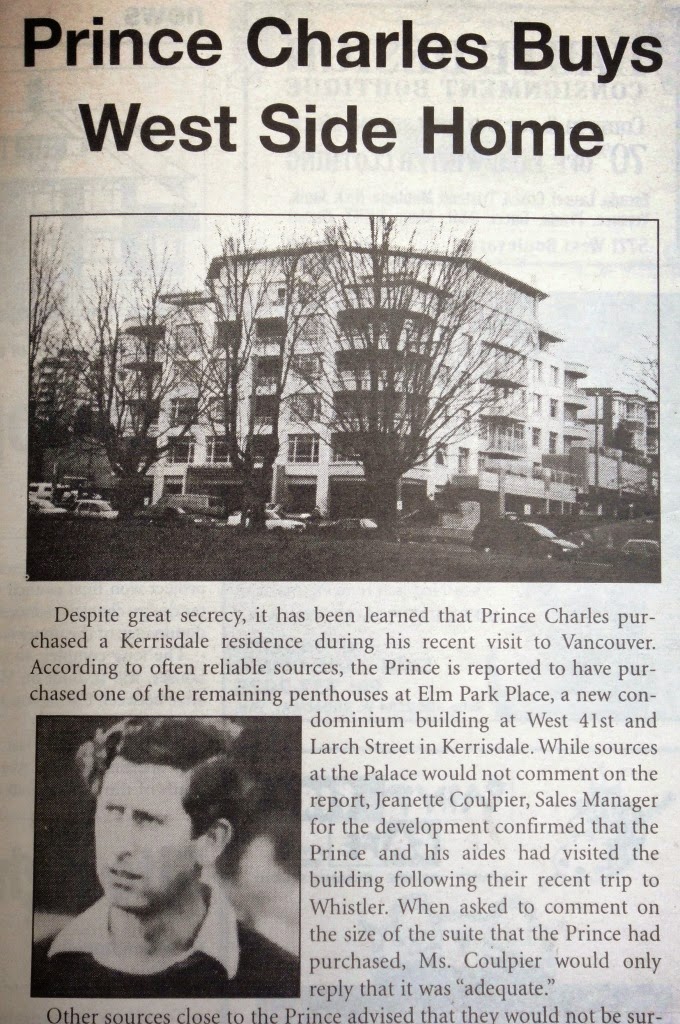
In 1998, I completed the development of Elm Park Place at the corner of West 41st and Larch Street. I often advertised the project in the Courier and, when I realized there would be an April 1 edition, I decided to have some fun. It was shortly after Prince Charles had visited the city. Instead of a conventional advertisement, I wrote an “advertorial” reporting that “according to often reliable sources, during his recent visit to Vancouver, the Prince had purchased a residence in Kerrisdale.
While the Palace would not comment, the purchase was rumoured to be one of the remaining penthouses at Elm Park Place.”

What I had not anticipated was the response from some pre-sale buyers who called my office as soon as their paper was delivered. How dare I sell to the royal couple without consulting with them? Imagine the security costs they were are now going to have to pay!
The following year I still had a few suites left. The RAV Rapid Transit along Cambie Street was very much in the news and this prompted another advertorial in the March 31 edition. It reported that the government was secretly planning a SkyTrain extension to UBC along West 41st Avenue and included an artist’s illustration of the SkyTrain running past Elm Park Place. The next day my youngest daughter came home from Crofton House School with a big smile on her face. “You’ll never guess what, Daddy,” she exclaimed. One of her new classmates, whose family had recently arrived from Hong Kong, brought a copy of the Courier to her classroom “show and tell” to let everyone know there would soon be SkyTrain to Crofton House School. My daughter tried to explain it was really her dad’s April Fool's Day joke, but the girl had never heard of April Fool's Day.

This year there will be no pranks. However, I am presenting a talk at SFU Wednesday evening on the theme “12 Great Ideas for Vancouver from Around the World.” Here is a preview:
  • Vancouver is surrounded by water. While we have SeaBus and the False Creek ferries, we could make better use of this water for transportation, like Sydney or Hong Kong, or for housing like some of the new Dutch floating home communities.
  • Other cities may offer lessons on how to make Vancouver a friendlier city.
  • While we hold festivals and events to bring people together, we could do more. For example, every April 1, Odessa, Ukraine holds Humorina, an entire day devoted to the celebration of humour. It is a tradition dating back to the 1970s.
  • Given our desire to be the greenest city in the world, perhaps Vancouver could hold an annual sustainability festival, or other similar events.
  • We also need more public spaces where people can gather and better neighbourhood and buildings designs to foster greater interaction.
  • Other cities around the world offer lessons on how we might also make Vancouver a safer and healthier place in which to live. Some of these ideas were incorporated in SFU’s UniverCity community development. Tonight’s presentation will look at how to make existing and new neighbourhoods healthier and safer.
  • Vancouver has many beautiful tree-lined streets and well-maintained gardens. However, compared to other cities, we could do a lot more to landscape the city and keep it clean and tidy. We will look at what Irish cities and towns have been doing, as well as other cities around the world.
  • Since transportation is very much top of mind these days, the presentation will include examples of rapid bus and tram systems that will hopefully come to Vancouver one day, as well as how we might make Vancouver a more pedestrian-friendly city.
  • When it comes to city planning, other cities have developed various approaches to create a more ordered and harmonious appearance. Is this something Vancouver should consider?
Wednesday's talk is at SFU Harbour Centre 515 West Hastings St. from 7 until 9. You can register at sfu.ca or take a chance and just come by. Of course, it is free. No fooling. 

- See more at: http://www.vancourier.com/opinion/columnists/vancouver-can-learn-from-other-major-cities-1.1810161#sthash.nOF75DhG.dpuf

Opinion: A new life abroad a good option for some Vancouverites March 24, 2015

Have you ever thought about starting a new life somewhere other than Vancouver?

I have been thinking about this after reading so many inane comments from No voters related to the transit referendum and also having recently spent time with two households who have done just that. They have begun new lives in new places.

In one case, a well-established Vancouver couple sold their house and purchased a new home at less than half the price in the south of France. They still maintain a small apartment in downtown Vancouver where they spend half the year. But their hearts are now in France where they are meeting new friends and starting new careers: one as an artist, while the other spends his time at the market, cooking, tending the garden and learning French.

The other individual is a Swiss engineer I met after booking accommodation in a small Riad hotel on the Moroccan coast. After successful engineering-related careers in Switzerland, France and Iran, he and his wife purchased a ruin inside the walled town of Essaouira, which they have beautifully restored into a small, elegant hotel. They live in a comfortable apartment on the first floor surrounded by antique furniture and carpets collected over the years. Each day they greet new guests who, like me, are initially put off by the property’s modest entry at the end of a narrow, crumbling lane, only to discover an exquisitely decorated hotel hidden behind the nondescript door.

When I asked the engineer why he decided to start such a challenging new life, he responded that you don’t start a new life, the life decides for you, provided you are open to new possibilities. He worried that if he stayed at home he would continue to tell the same stories to the same friends until they all died. Now each day is a new adventure filled with new people and many new stories.
When I mentioned to my wife that I was thinking of writing a column about starting a new life, she responded that most of my readers were not likely in a personal or financial position to even contemplate such a thing.

On the contrary, I thought. If they own a home in Vancouver, they are probably in a position to cash out and could afford to live half the year in most places around the world. Of course there will be complications for many when it comes to being with family and certain friends. But then with today’s household demographics and geographic dispersal, many families are already spread around the globe.
 
As my friend in France, whose son lives in Toronto, pointed out, he sees him about as often while living in France as he did when living year round in Vancouver.

As my friend in France, whose son lives in Toronto, pointed out, he sees him about as often while living in France as he did when living year round in Vancouver. Moreover, he now enjoys wonderful times with many Vancouver friends who, like me, come to visit him in France.

One of the other advantages of living in Europe is its accessibility to so many interesting places.
I recently flew from London to Madrid for approximately $35 return. My new French friend thinks nothing of going to Berlin or Barcelona for a weekend. There are some drawbacks. Since he has retired he has to live within a budget, but he’s enjoying that too.  He no longer can buy whatever he wants, but then the cost of living is much lower. He just wishes he had known about the eight per cent property purchase tax before he selected his new home since he had planned to spend that money on a small roadster.

As I reflected on the Swiss engineer and my friend, I also thought about all those people from Asia and elsewhere who are now starting to do the same thing in Vancouver. They too are often leaving jobs, family and friends behind, at least for part of the year, in order to start a new life in Vancouver.
While I suspect many do not yet realize or care how the outcome of the transit referendum might affect them, they are happy to be enjoying Vancouver’s many amenities. Even though they cannot catch a short flight to Hong Kong or Prague for an enjoyable weekend.
It’s something to think about.
- See more at: http://www.vancourier.com/opinion/columnists/a-new-life-abroad-a-good-option-for-some-vancouverites-1.1803013#sthash.qLgRZ8qo.dpuf

Have you ever thought about starting a new life somewhere other than Vancouver?
I have been thinking about this after reading so many inane comments from No voters related to the transit referendum and also having recently spent time with two households who have done just that. They have begun new lives in new places.
In one case, a well-established Vancouver couple sold their house and purchased a new home at less than half the price in the south of France. They still maintain a small apartment in downtown Vancouver where they spend half the year.
But their hearts are now in France where they are meeting new friends and starting new careers: one as an artist, while the other spends his time at the market, cooking, tending the garden and learning French.
The other individual is a Swiss engineer I met after booking accommodation in a small Riad hotel on the Moroccan coast
After successful engineering-related careers in Switzerland, France and Iran, he and his wife purchased a ruin inside the walled town of Essaouira, which they have beautifully restored into a small, elegant hotel.
They live in a comfortable apartment on the first floor surrounded by antique furniture and carpets collected over the years. Each day they greet new guests who, like me, are initially put off by the property’s modest entry at the end of a narrow, crumbling lane, only to discover an exquisitely decorated hotel hidden behind the nondescript door.
When I asked the engineer why he decided to start such a challenging new life, he responded that you don’t start a new life, the life decides for you, provided you are open to new possibilities.
He worried that if he stayed at home he would continue to tell the same stories to the same friends until they all died. Now each day is a new adventure filled with new people and many new stories.
When I mentioned to my wife that I was thinking of writing a column about starting a new life, she responded that most of my readers were not likely in a personal or financial position to even contemplate such a thing.
On the contrary, I thought. If they own a home in Vancouver, they are probably in a position to cash out and could afford to live half the year in most places around the world.
Of course there will be complications for many when it comes to being with family and certain friends. But then with today’s household demographics and geographic dispersal, many families are already spread around the globe.
As my friend in France, whose son lives in Toronto, pointed out, he sees him about as often while living in France as he did when living year round in Vancouver.
Moreover, he now enjoys wonderful times with many Vancouver friends who, like me, come to visit him in France.
One of the other advantages of living in Europe is its accessibility to so many interesting places.
I recently flew from London to Madrid for approximately $35 return. My new French friend thinks nothing of going to Berlin or Barcelona for a weekend.
There are some drawbacks. Since he has retired he has to live within a budget, but he’s enjoying that too.
He no longer can buy whatever he wants, but then the cost of living is much lower. He just wishes he had known about the eight per cent property purchase tax before he selected his new home since he had planned to spend that money on a small roadster.
As I reflected on the Swiss engineer and my friend, I also thought about all those people from Asia and elsewhere who are now starting to do the same thing in Vancouver. They too are often leaving jobs, family and friends behind, at least for part of the year, in order to start a new life in Vancouver.
While I suspect many do not yet realize or care how the outcome of the transit referendum might affect them, they are happy to be enjoying Vancouver’s many amenities. Even though they cannot catch a short flight to Hong Kong or Prague for an enjoyable weekend.
It’s something to think about.
- See more at: http://www.vancourier.com/opinion/columnists/a-new-life-abroad-a-good-option-for-some-vancouverites-1.1803013#sthash.qLgRZ8qo.dpuf