Thursday, February 27, 2025

Catch-22 and the Economics of Building Rental Housing


Those of you who read Catch-22 will no doubt like me have fond memories of the book. There are two aspects of the book that seem relevant to Vancouver's current rental housing crisis.

The first is how the squadron's Mess Officer, Milo Minderbinder, managed to buy eggs for seven cents, sell them to the mess halls for five cents, and still make a profit. As I recall, he claimed he made money on volume!

The other was Yosarrian who tried to get out of flying more missions. To get out of flying missions he had to prove he was mad. But that didn't work since anyone who wanted to stop flying missions couldn't be mad. Or something like that.

So why is Vancouver's rental market like this. Well, in order to bring down rents, we need to increase the supply of rental housing. But if rents do indeed come down, as they are, in part due to increased supply, then new projects will no longer be financially feasible. So eventually, rents will go back up. Are you following me? 

Russil WVong's post reporting on Cressey's numbers.

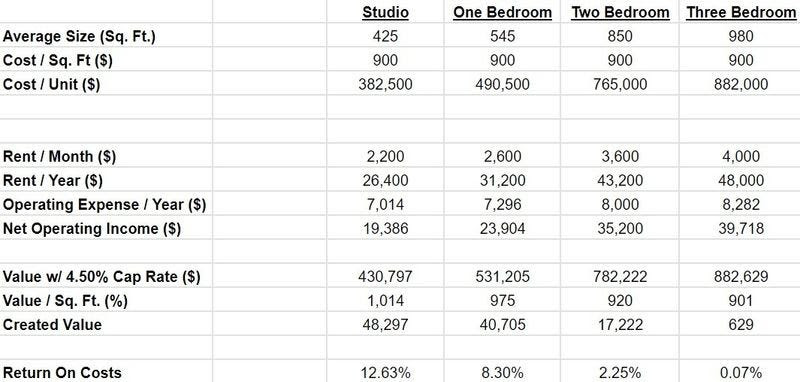
I thought about this today when I received an email from Russil Wvong. It offered several important observations. The first is that larger suites, which are most needed, are not financially viable. The cost is greater than the rent that can be charged. So they have to be subsidized by smaller suites that we don't really need.

While Cressey's numbers are overly simplified (a small suite is usually more expensive to build on a cost per sq.ft. than a larger suite, etc.) the point being made is absolutely valid.

The other point is that the more we build, the more rents come down, and as a result, we will not be able to build more, until rents rise again. That's why I thought of Catch-22. Read on!

The conclusion is right. We don't need to just reduce rents. We need to reduce costs. And one way to do that is reduce municipal fees. Fortunately, I think municipal politicians and officials are now getting the message. But if they don't, they just need to wait until a few more developments go into foreclosure. It won't take much longer.

Forwarded this email? Subscribe here for more

Vancouver needs more housing


A chart with a rundown of the costs, income, and returns, by unit size.
Economics for market rental. Cressey

Inside The Cost-Profit Analysis Of Three-Bedroom Units In Metro Vancouver. Howard Chai, Storeys, October 2024.

The city of Vancouver requires that market rental projects have a minimum of 35% apartments with two or more bedrooms. Strata projects must have a minimum of 25% apartments with two bedrooms, and a minimum of 10% apartments with three bedrooms. Family Room Policy.

The problem is, the 3BR and even 2BR apartments end up being cross-subsidized by the studio and 1BR apartments. This raises the floor for rents on studio and 1BR apartments.

"The real problem, though, is not that we don't make money off of the three-bedroom units, it's that we have to drive the revenue [higher] on the one-bedroom units in order to subsidize the three-bedroom units," Hani Lammam explains. "It's not good enough not to make money on it. In order for me to be able to finance the project, I have to average out a return across all of it, so what really happens is the one-beds are subsidizing the three-beds. That's really what happens."

Why don’t market rents for 3BR and 2BR apartments reflect the cost to build them?

Yes, $4,000 a month for an apartment in Vancouver may be an achievable price, but that becomes less true if families have options to rent a townhouse in Surrey or Langley for around the same price.

"Once you get to a certain rent or purchase price, as a buyer, I have options," said Lammam. "The one-bedroom or even two-bedroom apartment appeals to that young, upstart new family, but the moment that family grows, it's hard to stay in an apartment, and I don't think it's the ideal. I don't think a family wishes they can live in an apartment, I think they wish they can live in a house."

As asking rents decline, fewer rental projects are viable

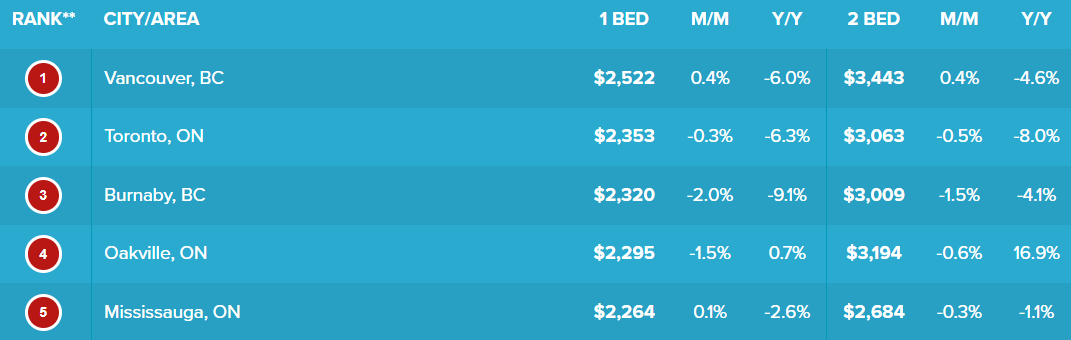
Of course the other headwind here is that asking rents are declining. The February 2025 report from rentals.ca says that the asking monthly rent for a 1BR in the city of Vancouver is $2522. For a 2BR, it’s $3433.

To keep building rental housing as rents decline, we need to reduce costs.

 
Like
Comment
Restack
 

© 2025 Russil Wvong
Vancouver, Canada
Unsubscribe

Get the appStart writing


Saturday, January 18, 2025

Another story about destruction caused by the Broadway Corridor Plan - Kerry Gold - Globe and Mail, January 17, 2025

I, and many others, appreciate the genuine interest and concern Vancouver journalist Kerry Gold has displayed in writing about the destructive aspects of the Broadway Plan. She has now written several articles about the failings of the plan, from the perspective of residents of more affordable rental buildings, and now property owners in the neighbourhood.

I hope you will read this article. But before doing so, I would like to elaborate on my concern with the city's requirement that 20% of the units be affordable. After all, this would seem most reasonable and important.

The problem is that the suites being designed for low-income families and individuals are often just awful. The city is giving away millions of dollars by waiving Development Cost Levies, yes millions, in order to get these suites included. 

Before you read the story below about the havoc the Broadway Corridor Plan proposals are creating, and what other respected voices have to say about the completely inapporpriate urban planning aspects of the plan, take a look at this floor plan for a lower income households in the building described in this story.

This is a three bedroom family suite. As a former CMHC social housing architect I can tell you that this layout, designed by the respected architectural firm of MCM, formerly Musson Cattell Mackie, is not livable. It does not even meet code. There isn't a coat closet. There are no bedroom closets; there is no washer or dryer, (although the developer says there is a European-style washer/dryer in the kitchen). The kitchen is so tiny, the kitchen sink is right next to the stove, which is illegal, and I can't see adequate space for a dishwasher. Can you? Any of you?

CORRECTION. Kerry Gold and I previously wrote that the city's record of comments related to this development included the following comment from architect Peter Busby: "The proposal is ludicrously out of proportion to the neighbouring buildings, and an offence against common sense urban aesthetics." 

We are now advised that the architect Peter Busby did not write this. It may have been another Peter Busby or someone pretending to be Peter. Kerry Gold and I apologize to Peter for being duped by this comment as found in the City's record of correspondence. A copy of an email exchange between the City and Peter can be found at the end of this post.

Why does this building look like Bentall Centre? 
Frank Musson, a gentleman I highly respect was the architect for the 1970's Bentall Centre. I mention this since this building seems like a bulky, 1970's building dropped into a lovely, tree lined residential street full of duplexes and single-family houses.The developer and city planner both assured city council that the existing street trees would be kept. 

Will the existing trees be kept as promised by the developer and staff? 
However, if you look at this drawing you'll see the existing street trees are gone. Instead they are replaced by some smaller trees. And if you look even closer, you'll see the shadows from the sun assume the sun is in the north. Why, because the developer doesn't care and the city staff are too busy to notice these things.MCM should be ashamed of itself for allowing this building design and drawing to be released to the public

At the public hearing for this project a structural engineer who lives nearby says it will be impossible for the developer to save the existing trees. Why? Because it will not be possible to safely erect a crane to construct the building without taking out the trees.

What I don't understand is why the Mayor and sensible members of Council aren't demanding more of their staff when it comes to projects like this. Why are they allowing them? I suspect it is just to get the 20% below market units. 

The mayor says he wants to do the right thing. 
On Tuesday morning I was at a breakfast with the mayor, who, along with Trevor Ford, his Chief of Staff assured those of us present that the city really does care. about the community and doing the right thing. If this is the case, I hope city politicians and staff give us some answers.

Will the existing street trees be kept?

Will the building be completely redesigned so that the below market unit sizes are all increased and made livable?

Will some effort be made to ensure this building is redesigned to fit in better with the street?
And finally, 

Since there are more than 10,000 rental units currently being contemplated along the corridor, why doesn't the city impose a moratorium on new projects at places like 1st and Yew and the streets like West 14th and 15th, far away from Broadway? Why not focus new buildings along Broadway and the streets immediately to the north and south, and around transit?

As one of my critics wrote on Twitter, why pay attention to an affluent old man like me, with old-fashioned planning ideas, when I'll be dead when the plan is being implemented? 

I would suggest the real question should be why am I speaking out and alienating staff and members of Council, (one of whom recently told a mutual colleague that "I think Geller is losing it" when I will be dead when the plan is being implemented?

The answer is because I care about this city, and as I was quoted in the 500 Dunsmuir story, (prviously posted on this blog) the city council has become so obsessed with doing what they think is right to create more affordable housing, they are disregarding the things that made Vancouver such a special place to live in recent years.

W

Jennifer Irvine purchased her Kitsilano duplex on Vancouver’s west side eight years ago, but now that her neighbours have assembled their properties to develop an 18-storey tower, she says her leafy picturesque street is undergoing a new form of blockbusting.

Last fall, a company called Havn Development obtained a rezoning permit on behalf of three property owners with a proposal to build a 170-unit rental tower with podium at 2156-2172 W. 14th Ave., between Yew and Arbutus streets. The site currently consists of a detached house and two duplexes, but the city has plans to create a second downtown for the low- to mid-density neighbourhoods within the 500-block Broadway Plan. That includes the approval of high-rise towers in the middle of quiet side streets.

“At this stage, when the fear happens, people just go, ‘Okay, I guess that’s it. I’m out,’” said Ms. Irvine, a retired city hall employee. “I’m not ready. I knew I was going to leave this place, but I assumed I would when I wanted to, and I would sell it to somebody who really wanted to live here. I’m not ready.”

Unlike lower forms of density, the prospect of high-rise towers sends a ripple of fear that is uprooting neighbourhoods. Thousands of renters in the Broadway Plan are being displaced by proposed redevelopment of their older buildings, while homeowners are planning to leave for their own reasons.

The W. 14th Avenue project, critics say, is an example of how the new blockbusting works. It starts when a homeowner decides to cash out to an investor or developer, often at a premium and then neighbours must decide whether to endure years of construction and living adjacent to a tower – or also sell and move on. The resident living near the tower might see their home lose value, unless they too can become part of an assembly. But there is a limit on the number of towers per block, so not everyone can get in on the tower action.

“If by virtue of their location they are not able to sell their property for a similar tower development … the value will go down,” said developer, real estate consultant, urban planner and retired architect Michael Geller, who’s in favour of high-rises but is adamantly opposed to the W. 14th proposal. His concern is as a planner; he lives outside the Broadway Plan.

“If another tower is permitted on the adjacent lots, and their lot could be part of an assembly, it might increase. But generally, a tower next door or even across the lane will likely reduce the value if the property is likely to stay as a single-family house or duplex.”

Ms. Irvine said her street has become more divisive, and she questions if the stress will be worth it. Will truly affordable housing be the result? Havn Development has two other rezonings within the Broadway Plan area, all remarkably similar, but the company has no track record of previous developments, which has made some wonder if they are planning to flip the property.

Adrian Lai, of Havn Developments, said they intend to apply for a development permit this year and follow through with construction. He said they have no intention to sell the site.

”As a developer we have done some smaller scale projects. This would be the first sort of large multifamily project that we have done. But just because we are new doesn’t mean we don’t have the ability to execute,” he said.

”I do sympathize with the people in the neighbourhood – it’s a big change. I’d probably feel the same way if I were in their shoes,” said Mr. Lai. “But we are following the Broadway Plan. We are not doing anything not permitted within the Broadway Plan.”

Council approved the project despite considerable public pushback.

Architect Peter Busby called the proposal “ludicrously out of proportion to the neighbouring buildings,” and “an offence against common sense urban aesthetics.” He argued that the building should be limited to six storeys.

Former Vancouver mayor and B.C. premier Mike Harcourt said the plan is “totally inappropriate and out of scale to this fine old neighbourhood.”

Aimee Gabor is a retired realtor whose lane backs onto the W. 14th proposal, and her daughter lives next door to the tower project. Ms. Gabor and her husband hope to stay in their duplex with their grandchildren down the alley. But she said there’s a sense that busting up the neighbourhoods might be an intended consequence.

“The city wants to increase density, which is wonderful, but they didn’t consult us about what would fit in because they don’t want us to live here. They want us out,” she said. “This is the plan for pushing out the people from this beautiful neighbourhood, to push them out and build another [neighbourhood] like the north side of the False Creek,” she said, referring to the downtown area packed with skyscrapers. “That is what they want to turn Kitsilano into.”

Mr. Geller is calling for a moratorium on side street towers two blocks outside Broadway. The middleman that assembles properties and flips them only drives up prices, which won’t result in affordability for the end-user, he said. Market rents for new purpose-built apartments are about $5.50 per square foot, or $2,200 for a 400-square-foot unit.

He also criticizes the city policy that requires 20 per cent below-market housing because the other 80 per cent usually subsidizes those units, which makes those market-rate rentals expensive and drives up the rents for the area. Politicians are approving poorly designed buildings just to get the 20 per cent below market rental units, he said.

Filmmaker David Fine, an Oscar winner who’s making a documentary about the Broadway Plan displacements, has become a community organizer.

“No one is saying, ‘don’t build towers anywhere,’ but [instead] there should be a process for building out from transit and adding considerable densification in these areas.

“But why are people and their opinions and views completely meaningless to the city?” he asked.

“I think there is a school of thought that says, ‘if we can drive people out of their homes and build towers instead, then the city is better off, because we are building more density, and you can double property taxes.’

“I just feel it’s a cruel way to develop a city … and the social fabric is not being respected in any way.”

Email exchange re: Peter Busby comment.


Another story about 500 Dunsmuir which will be demolished today. John Mackie, Vancouver Sun, January 18, 2025


Should the facade of the Vancouver heritage building at 500 Dunsmuir St. be retained?

The former Dunsmuir Hotel has been vacant since 2013.

By John Mackie Published Jan 16, 2025

Built in 1907, the Dunsmuir Hotel was initially a large tourist hotel and in recent decades has been an SRO. Vacant since 2013, the City of Vancouver has ordered it torn down because it's in bad shape.

The demolition of the red-brick heritage building at 500 Dunsmuir St. is to begin Friday morning, but unlike some earlier cases, the facade of the 115-year-old former hotel will not be preserved.

In the past, the city has encouraged developers to preserve the facades of heritage buildings. The 1901 Terminus Hotel at 36 Water St. was largely destroyed in a fire in 1998, but the facade was saved and propped up by steel beams for several years before it was incorporated into a condo development in 2006.

There’s also a heritage facade project currently being built at 150 Robson St., where a 29-storey condo tower will rise behind the facade of the 1928 Catholic Charities building.

The order to demolish 500 Dunsmuir came from the city’s chief building official due to public safety concerns.

But planner/real estate consultant Michael Geller still believes part of the facade could have been preserved.

“I’m not a chief building official, so it’s dangerous or foolish for me to contradict him,” said Geller. “But going down to the site and looking at it, yes, there were portions of that building that were in terrible shape and the walls were cracking, but the most important facades along Dunsmuir look just fine.”

Civic historian John Atkin said that saving the facade would be tricky, and costly.

“Part of the problem is the design of the building,” said Atkin. “It’s not a single facade across the front, it’s actually three narrow facades with two sides in an end piece … The structural damage is such that the complexity of the steel work to hold that brick work up would mean you wouldn’t be saving anything really worth saving.”

Still, Atkin said the facade could be rebuilt in a new development.

“You would say to (the developer), Holborn, ‘This building is dangerous, you have to demolish it,’ ” he said. “ ‘And a condition of any development permit for anything you do on the site is the reconstruction of the side and front and inset facades as accurately as can be done.’ ”

In an email, the city of Vancouver said “the property owner may be required to incorporate or replicate heritage features as part of their redevelopment plan. The details will depend on what is being proposed by the owner.”

But, it added, “due to concerns about potentially hazardous building materials, the property owner will not be required to retain building materials.”

The pending demolition of 500 Dunsmuir is a case of what heritage activists call “demolition through neglect,” where a building owner lets a building sit vacant for several years, it deteriorates and is torn down.

In this case the building had been vacant since 2013. Holborn owns most of the block around 500 Dunsmuir, including The Bay parkade.

“It’s a heritage building but the company that owned it really wanted to see it demolished so that they could then redevelop the entire block,” said Geller. “And so they simply neglected it, and for reasons that are harder to understand, the city just simply allowed the building to deteriorate.”

Geller said heritage doesn’t seem to be a priority with the city.

“There just doesn’t seem to be the same interest in protecting heritage or protecting views,” he said. “Everybody is simply obsessed with trying to bring down the cost of housing to the point that we’re going to lose all of the things that made Vancouver so special.”

The city said in its statement that it was “disappointed that the owners of Dunsmuir House, a building with significant heritage value, neglected the building to the point where demolition became the only viable option to ensure public safety.”

“Property owners have a responsibility to keep their buildings safe, and allowing a property to fall into disrepair and become a hazard to public safety is unacceptable.”

A message to Holborn CEO Joo Kim Tiah wasn’t returned by deadline.

The company has been at odds with the city and province before. It owns the controversial Little Mountain site, where hundreds of low income residents were displaced and the site is largely vacant, almost two decades after Holborn purchased it.

The block around 500 Dunsmuir is zoned commercial but Holborn has been angling to build residential. The company released architectural renderings with three condo towers on the block in 2020, including one that went up to 900 feet, the equivalent of 90 storeys

But that plan included the retention of 500 Dunsmuir, which started out as the Hotel Dunsmuir tourist hotel, became a Salvation Army men’s shelter called Dunsmuir House and was last rented as an SRO to B.C. Housing in 2013.

After it became vacant, the City of Vancouver tried to collect an empty home tax on the building, which had 187 SRO units in 2013. But The Tyee reported Holborn took the city to court, arguing the city had rezoned it commercial. The city dropped the empty homes tax request.

“You can charge the empty home tax (for residential apartments or houses), but you can have an empty (commercial) building,” said Atkin.

The city can charge a developer a $300,000 per lost SRO unit. If the city charged that for 187 units, it would be $56,100,000.

The Union of B.C. Municipalities has asked the provincial government to allow municipalities to charge a tax for empty buildings.

jmackie@postmedia.com


Tuesday, December 31, 2024

MACLEANS Magazine's 12 Housing Predictions for 2025


At the end of each year, I like to offer predictions for the year ahead and share them with readers of the Vancouver Sun and this blog. Today, I came across12 Housing Predictions offered by MACLEANS Magazine. While some are truly predictions, others, including "BC will tax house flippers" are already known facts. But I will be interested to see which come true a year from now. Personally, I think all will turn out to be correct!

THE YEAR AHEAD 2025 - Ten Housing Predictions for 2025

Politicians will spar over how to tackle the housing crisis. Falling interest rates will draw young people into the real estate market. And a rude awakening is coming for homeowners renewing mortgages.

December 30, 2024

1. Toronto’s Condo Market Will Plummet

After a few years of stagnant pricing, the Toronto condo market is poised for a plunge. In the first half of 2024, sales of newly built condos fell by 57 per cent year over year—the biggest slowdown since 1997—largely due to high interest rates. The number of condo listings is now much higher than recent averages, and sales remain low. TD says prices will keep declining, then recover modestly by year’s end. Then we may face the opposite problem: since the downward trend has spooked condo investors, who account for 70 per cent of pre-construction sales, condo starts have also dropped dramatically. In the long run, that could mean a condo shortage, driving prices up again. 

2. B.C. Will Tax House Flippers

Bad news for West Coast real estate investors: on January 1, British Columbia will implement a flipping tax aimed at curbing short-term investments and boosting the province’s minuscule vacancy rates. The first of its kind in Canada, the tax will apply to those selling property they’ve owned for less than 730 days, with some exceptions for circumstances like job relocations, deaths and divorces. Sellers who’ve owned their homes for 365 days or less will be taxed at 20 per cent of income on the sale, with the rate gradually decreasing to zero by the two-year mark. The rule is in addition to the federal flipping tax, introduced in 2022, which makes the capital gains from the sale of a home taxable as business income.

3. Interest Rates Will Keep Dropping

The Bank of Canada has finally tamed the beast of inflation—but the national GDP outlook looks less than rosy. As a result, the BoC will keep chopping interest rates through 2025, likely at a similar clip as in 2024. As rates decrease, more buyers will pour into the market, fuelling more competition. Softened lending rules will also heat up the market. The government has raised borrowing caps for mortgages secured with a down payment of less than 20 per cent from $1 million to $1.5 million. It also extended the maximum amortization from 25 to 30 years for some mortgages. The changes will make borrowing accessible to more buyers—many of whom will start house-hunting in 2025.

4. U.S. Firms Will Pour Billions into Canadian Real Estate 

What we call a runaway housing market, U.S. real estate firms call an opportunity. Soaring prices, skyrocketing rents and a growing population that’s unable to afford either have created massive demand for purpose-built rentals. Blackstone, the largest private-equity firm in the world, bought Canadian rental housing owner Tricon for US$3.5 billion in May. Meanwhile, Texas-based developer Hines LLP is planning to invest up to $2 billion in land for large-scale, six- to eight-storey apartment towers in cities like Toronto, Vancouver, Calgary, and Montreal. It’s also interested in reviving projects that have been stalled in the past few years by high interest rates and construction costs. It’s a good time to do business with Canada: the governing Liberals cut the five per cent tax on new rental builds and now offer cheaper financing to builders who will try to help dig us out of our own mess.

5. Labour Shortages Will Cause Construction Delays

The next decade will be a challenge for Canada’s battered construction industry. Between now and 2033, we’ll lose 263,000 construction workers to retirement. That was predictable. Making things worse: only about two per cent of Canada’s newcomers over the past decade have skilled-trade qualifications. Domestically, young Canadians are also increasingly choosing white-collar careers over blue-collar ones. All of this will put the brakes on Canada’s ambitious goal of building 3.9 million homes nationwide by 2031.

6. First Nations Will Be the Big New Developers

In 2025, Indigenous communities nationwide will be leading the charge on housing. The country’s most impressive project is Sen̓áḵw, a cluster of 11 skyscrapers in Vancouver with 6,000 residential units, developed on land belonging to the Squamish Nation. Its first three towers will be done in 2025. The Attainable Housing Initiative, a B.C. government project on Indigenous land, will deliver 2,600 homes with 40 per cent subsidies starting in the spring. And, on the Prairies, the Southern Chiefs’ Organization, representing 33 Anishinaabe and Dakota nations, will develop a residential tower in the middle of downtown Winnipeg.

7. More Millennials and Gen Zs Will Buy Homes

Thanks to declining interest rates, rising wages and, to a lesser extent, the new option of completing an entire mortgage application online, far more millennials and Gen Zs will eye homeownership than in recent years. A nationwide Scotiabank poll revealed that more than half of non-homeowning Canadians aged 18 to 34 plan to buy a home at some point in the next five years. That’s promising news: according to the same Scotiabank poll, only 26 per cent of 18-to-34-year-olds own a home today, compared to 47 per cent in 2021, and 35 per cent live with their families. In 2025, they’ll become bigger players in a hotter housing market.

8. A Wave of Mortgage Defaults Is Coming

In 2025, more than a million households will face mortgage renewals at elevated interest rates. The banks are ready for it, having already set aside more than $4.5 billion in provisions for credit losses. The fallout from broken mortgages isn’t just bad news for homeowners, but for the economy at large. Canadian households are already among the most indebted in the world and, as defaults rise, banks may need to reserve more capital, triggering a credit crunch and making borrowing harder.

9. Edmonton Will Implement Automated Permits

Edmonton is set to become Canada’s first municipality to use AI for building-permit approvals. In 2025, it will roll out its Auto Review program, allowing builders to apply for permits for detached and semi-detached homes online and receive approvals the same day. This initiative aims to boost Edmonton’s construction industry, which has struggled to keep up with the city’s population boom—up 12 per cent to 1.1 million over the last five years. 

10. Poilievre Will Eliminate GST for New Homes

If his party forms a government, Conservative Leader Pierre Poilievre plans to one-up the Liberals’ tax cut for rental builds, slashing GST for all newly built homes under $1 million. Housing wonks agree that the plan will jump-start homebuilding. But there’s a catch: to pay for it, Poilievre will eliminate the Liberals’ Housing Accelerator Fund and the Canada Housing Infrastructure Fund. Those efforts are intended to help cities fund infrastructure improvements, in exchange for loosening zoning rules. In 2024, they resulted in a wave of density-boosting zoning reforms across the country.


Monday, December 30, 2024

STOREYS - 2025 Predictions - Kerry Gold


As I wrote in my recent Vancouver Sun year-end forecast article, according to Yogi Berra, it's hard to make predictions, especially about the future. That said, here is Kerry Gold's article published today with several predictions from some thoughtful, knowledgeable people, and me! 

As far as year-ahead predictions go, industry observers say not much will change from this year to next in the Vancouver housing market, despite interest rate drops – though some trends standout.

Kerry Gold 

December 30, 2024

As far as year-ahead predictions go, industry observers say not much will change from this year to next in the Vancouver housing market, despite interest rate drops.

Realtor and investor Bryan Yan, who has a solid record of market forecasts, said the prime rate must drop to below 5% for price escalations between five and 10%. Right now, at 5.45%, it’s not enough to shift the market into a higher gear, and so he expects a buyers' market to continue.

“Most places are selling at or below assessment, about 5% below assessed value right now,” said Yan. “So, if your listing agent sells above assessment, you should buy them lunch, because that’s not happening.”

What is happening is the fear-of-missing-out buyer (FOMO) that fuelled the pandemic years has been replaced by a buyer more willing to throw money around. Yan is also seeing a trend play out, which is an increase in listings for estate sales by executors. Now flush with cash, these estate beneficiaries are usually willing to pay more for a property because they didn’t earn the money.

“The age of the FOMO buyers is gone, and YOLO [you only live once] buyers remain. In the last three years, the FOMO buyers have been burdened with high interest rates and payments. But right now, the inheritance-based real estate market is taking off. In the next two to three years, it’s estimated [by Chartered Professional Accountants Canada] that around $1 trillion will pass to the heirs as inheritance in Canada. You see that now with a lot of sales. It’s started,” said Yan. “So, we are in an inheritance-based real estate market. And not just by death, but by parents giving their kids an early inheritance, with a warm hand instead of a cold hand.

“So, these guys say, ‘Why not buy? I got the money through my inheritance.’”

The Royal LePage annual Market Survey Forecast is also expecting a tepid year for Vancouver, with home price increases of 4% for the region, while forecasting gains of 5% for Toronto and 6.5% for Montreal. Calgary, Ottawa and Winnipeg are also expected to see modest 4% gains, according to the report.

“Over the past several months, supply has been building in the Toronto and Vancouver real estate markets as sellers responded to early interest rate cuts by listing their homes. However, with home prices in these cities remaining high, many sidelined buyers continued to wait for more favourable borrowing conditions,” Phil Soper, President and CEO at Royal LePage, explained in the report.

“Flat property prices also reduced the urgency often driven by fears of ‘missing out,’ creating a temporary stalemate where inventory lingered, and buyers hesitated to act. By mid-fall, this dynamic began to shift as buyers re-engaged with the market,”

In Greater Vancouver, listings dropped from around 14,000 to 15,000 to approximately 10,000, as sellers removed their homes from the market as the buying season ended, says Randy Ryalls in the report. He’s hoping those homes taken off the market will return by spring. And a lower bond yield and lower fixed interest rate would have a big impact on market conditions, he adds.

“If that bond market weakened a bit, and those longer-term rates could come down another half a point, something like that, it would probably spark buyers to get back into the market,” said Ryalls.

“Buyers are not coming out in big numbers, although we saw a nice jump in October, after that second to last interest rate cut by the Bank of Canada. [Overall] transactional volume in Greater Vancouver took a nice jump, about 30% year over year. November carried on, not to that degree, but still pretty good numbers. We were trending in the right direction.”

The presale market is the hardest hit, and developers are having a tough time, he added. Lowering prices to spur buying activity isn’t as easy as it sounds.

“A lot of people have been fence sitting, but prices are not adjusting down. There are a number of reasons why. Number one is that banks won’t allow it to happen. The developers have to hit their numbers or the project is a no go,” he said.

“Developers have been pumping the brakes quite a bit hoping for better market conditions.”

Developer Hani Lammam, EVP of Cressey Development Group, said that the top-end downtown rental market that aims for rents of $5.50 per foot and higher is “unsustainable based on local incomes.”

“The demand is there, but they simply cannot afford the exorbitant rents being asked in certain circumstances,” said Lammam.

Developer and consultant Michael Geller said there is not one overall market for Vancouver this coming year. Rather, the region will be divided into sub-markets, each with its own unique flavour. Developers will have to respond to diverse sub-markets.

“What applies to East Vancouver may not apply to Burnaby or Richmond,” he said.

Geller said that the experienced players in the development industry will target end-users such as first-time buyers, move-up buyers, and empty-nesters. The investor is no longer the focus of a presale program, he said. The glut of purpose-built rental units coming online, combined with restrictions around foreign buyers and short-term rental platforms has taken the steam out of the investor-driven presale condo market.

And the federal foreign buyer ban, extended to last until 2027, may have had an impact on Vancouver’s pricey luxury market, both rental and ownership.

With price-sensitive demand, Geller said smart developers and architects will get more creative about their designs.

“Consideration should be given to designing projects containing suites that could appeal to those interested in co-purchasing,” he said. “These could include one-bedroom units where the living room can become a separate sleeping room at night and two-bedroom units with two similarly sized ensuite bedrooms.”

Real Estate News


Sunday, December 22, 2024

50 Years After. Musings on what has changed since 1974

When younger people see an old, bald, overweight man, it's often difficult for them to appreciate that he didn't always look that way. Yes, this is me when I arrived in 1974. I was 27. 

When the Vancouver Sun invited me to comment on what might happen to Vancouver’s housing markets in 2025, I could not help but think back fifty years to 1974 when I arrived in Vancouver to become Canada Mortgage and Housing Corporation’s assistant architect/planner for British Columbia. 

My responsibilities included overseeing the initial planning for Granville Island and the city’s proposed redevelopment of the South Shore False Creek. I also participated in the design and loan approvals for thousands of non-profit rental and cooperative housing units funded by CMHC throughout British Columbia. These included developments by various community, faith-based, and ethnic groups.

As Program Manager Social Housing, at the beginning of December, I phoned up non-profit sponsors to see if they had a project needing funding, since I still had funds to allocate!

Inclusionary Zoning vs Non-Profit Housing

Today, non-profit housing continues. But municipalities increasingly look to the private sector to fund affordable housing through Inclusionary Zoning (IZ).

 “If you include 20% affordable homes, we will let you build a much larger building.”

Unfortunately, while many projects have been approved or are going through the approval process, often with fervent neighbourhood opposition, many of these projects will not likely get built. Notwithstanding the higher densities which were intended to bring down land costs, provincial and municipal policies are not having the desired effect of bringing down land prices on a per sq.ft of buildable area. Furthermore, as a result of the combination of higher land costs, higher construction costs (in part due to higher energy requirements), higher lending interest rates, and excessive municipal fees and project approval delays are making many projects no longer financially feasible.

Rather than rely on the private sector to build highrise buildings at excessive densities which do not fit with their neighbourhood context, municipalities should promote smaller multi-family buildings and seek a return to the 1974 level of federal and provincial funding. We should also bring back programs like MURBs and AHOP. 

When I arrived, CMHC was administering this affordable ownership program. I remember accompanying my boss to a meeting in Surrey since some homebuyers were upset their single-family home didn't have doors on the closets. I told them they shouldn't be complaining when they could buy a 1200 sq.ft. detached house for $47,000. Hopefully they remember this, since today those homes are worth 30 times what they paid!


How many homes can we build each year?

In 2023, the Trudeau government announced its new affordable housing plan which included the promise of 3,870,000 new homes by 2031. This equated to an average of 483,750 homes every year.

To put this in context 257,243 homes were built in 1974 across Canada. This is more than have been built in any year since. 

According to CMHC, approximately 240,000 homes were started across Canada over the past 12 months. However, Vancouver starts were down 18% from 2023 due to increased construction costs, higher municipal fees, and higher interest rates.

Higher Interest rates?

In 1974, the prime rate reached 11% and a 5-year fixed mortgage was 12%. Seven years later, in August 1981, a 5-year fixed mortgage peaked at 21.75%. 

1974 was also the year the NDP government introduced Rent Controls in BC. That year the annual rent increase was capped at 12%. Yes, 12%. The legislation linked rent to the unit.

In 2024, annual rent increases were limited to 3.5%. The 2025 limit is just 3%. Rents are no longer linked to the unit. Instead, they are linked to the tenant, and consequently, when a tenant moves out, rents usually increase to make up for inflation.

The Green Party and others are now proposing that rents be again linked to the unit, not the tenant. While this seems like a good idea for renters, it may not be since it would most certainly result in a significant decline in rental housing starts. 

Unless two things happen. 

The first is if allowable rent increases reflected increases in taxes, energy costs, and other maintenance and operating costs. 

The second is if British Columbia follows Ontario and allows new construction to be exempt from rent controls all together. This has been its policy since 2018.

While the first idea will not happen in 2025, I would urge the provincial government to consider implementing the second idea.

In my 2023-year end article I wrote that as we approached 2024, many British Columbians, especially those facing mortgage renewals, would be worried about future interest rates, house prices and rental costs.

I reported that although most economists agreed interest rates were not likely to increase, there appeared to be little consensus on what else might happen. I expected new housing costs to increase, with a corresponding increase in existing housing prices, since a rising tide lifts all boats.

In fact, interest rates did come down. Home prices were little changed, although rents declined. This has been attributed to a combination of increased supply and decreased demand since many renters left the province or moved in with parents.

In 2025, three factors could impact home prices and rents. 

These are whether the federal government achieves its reduced immigration targets; what happens to municipal fees; and whether Canada experiences a recession, or remains in a recession which former Bank of Canada governor Stephen Poloz believes we are already in.

Prices could also be impacted by Bills 44 and 47. Bill 44 allows multiplex homes on every single-family lot throughout the province in communities with a population greater than 5,000. 

Bill 47, also known as the Transit-Oriented-Area Act allows much greater building heights and densities within 200 m, 400m, or 800 m of a transit station or bus loop. 

Last year I wrote there was considerable uncertainty about the potential impacts of this legislation since if municipal engineers determined sewer and water infrastructure was inadequate without upgrades, projects would not proceed.

As we look to 2025, we need to consider two related questions. How should municipalities fund the cost of these services, and how might Bills 44 and 47 and other zoning changes impact property taxes?

Publicly funded infrastructure

Without new infrastructure being funded by government through taxes and local improvement charges, rather than by private developers and new homeowners and renters, I predict that we will not see the tens of thousands of new rental and condominium homes that so many are hoping will be built.